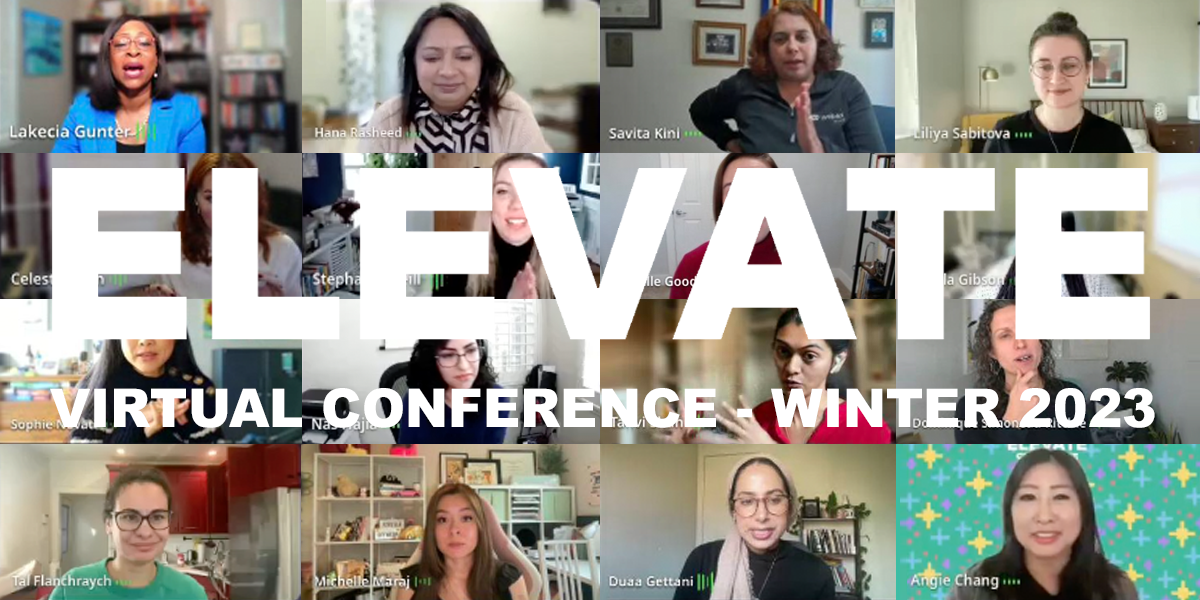
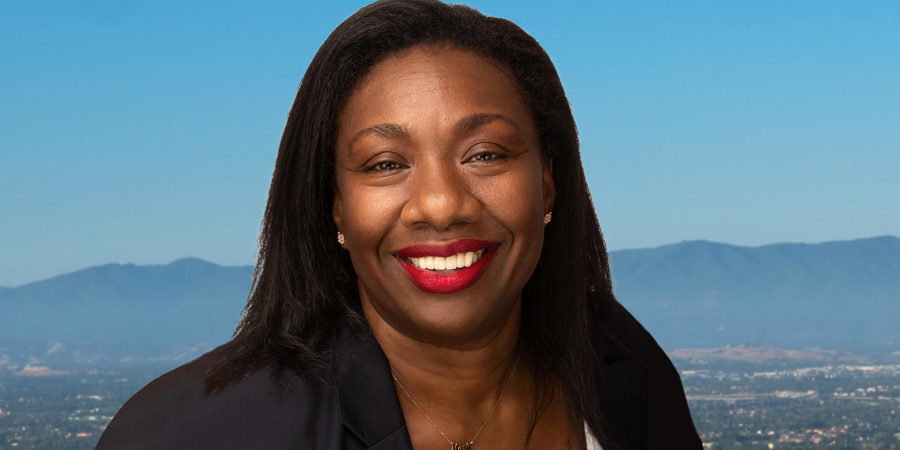
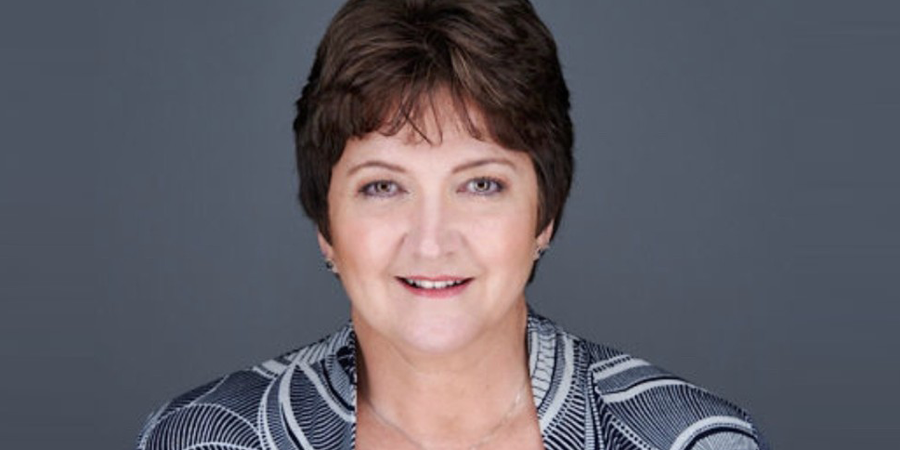
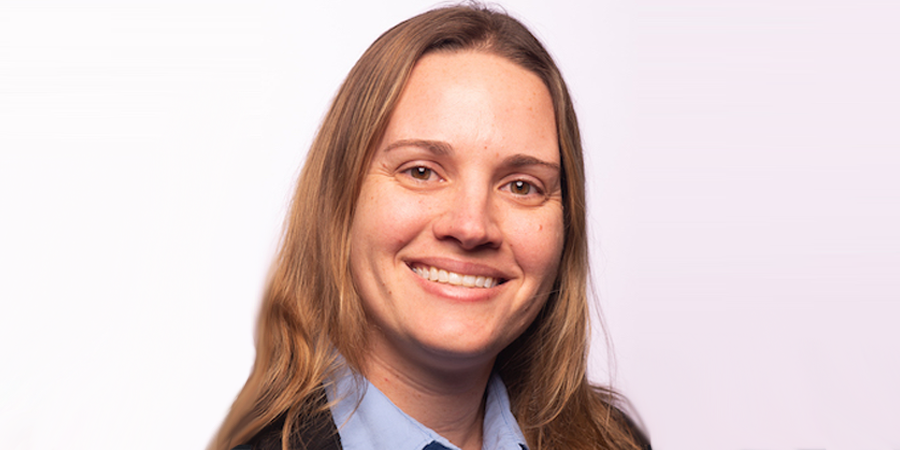
“Keynote – Lift Her Up: It Is Time to ROAR into 2024”: Lakecia Gunter, Chief Technology Officer, Global Partner Solutions at Microsoft (Video + Transcript)

Elevate conference keynote speaker Lakecia Gunter shares her personal journey in tech and the importance of building supportive networks. She highlights the impact of leaders who believed in her and invested in her career. Gunter emphasizes the need to say yes to opportunities and cancel self-doubt, and encourages attendees to reflect on their vision, seize opportunities, take action, and build relationships.

Transcript:

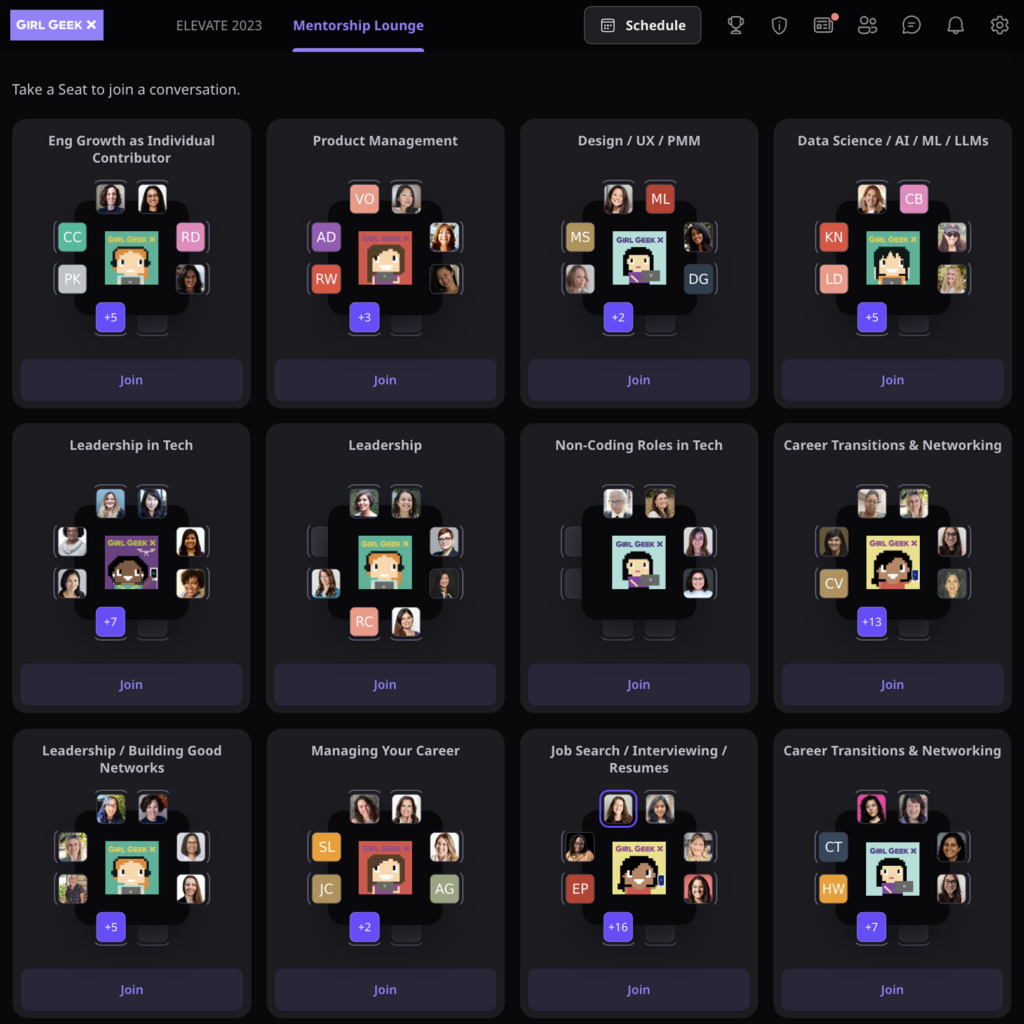
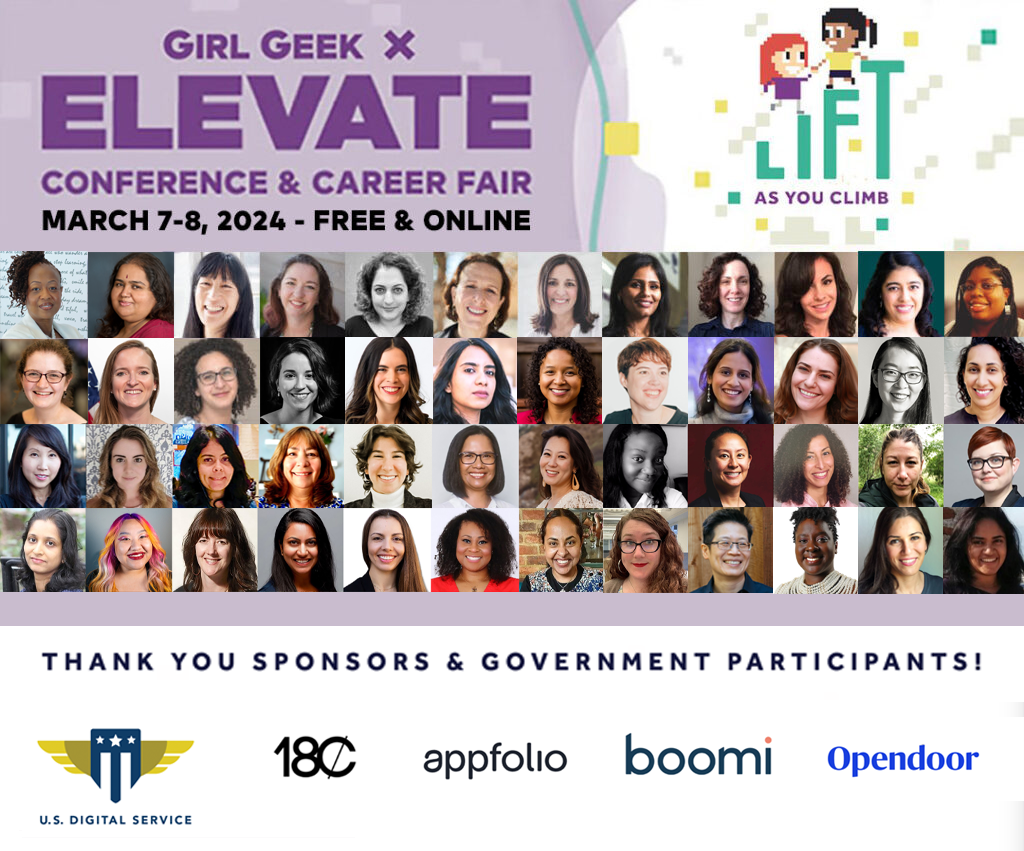
Angie Chang: Welcome to the Winter Elevate Conference. My name is Angie Chang. I’m the founder of Girl Geek X, formerly known as Bay Area Girl Geek Dinners where we hosted over a decade of Girl Geek dinners in the San Francisco Bay Area and over five years of virtual Elevate conferences where we’ve created opportunities to give even more women the mic on stage. So thank you for joining us. Every quarter, we’ve been gathering over a thousand women online for career and tech talks, networking first annually on International Women’s Day and now quarterly at Elevate virtual conferences. And this time we have added two mentorship hours in the mentorship lounge, which people are just coming in from. We just started that in this fall and we found it to be a great success for having dozens and dozens of women experts in tech, AI, LLMs, data science, non-coding roles in tech, volunteering to share their expertise with women in tech online around the world.

So thank you so much for all of the volunteers who’ve just joined us from that mentorship lounge and that mentorship lounge is a place where we hope you make connections at people on LinkedIn and stay in touch. There is a second mentorship hour that will be happening at 1:00 PM Pacific Time and you can visit the mentorship lounge to meet even more mentors. It’s a different set of mentors, so I encourage you to go look at the list of mentors will be joining us in the afternoon and the Girl Geek X team will be in a booth in Elevate on this platform. So if you want to meet us and talk about potentially sponsoring one of our virtual events or hosting a Girl Geek dinner at your company, head over to our booth to meet the Girl Geek X team and ask any questions you have about potential partnership or sponsorship.

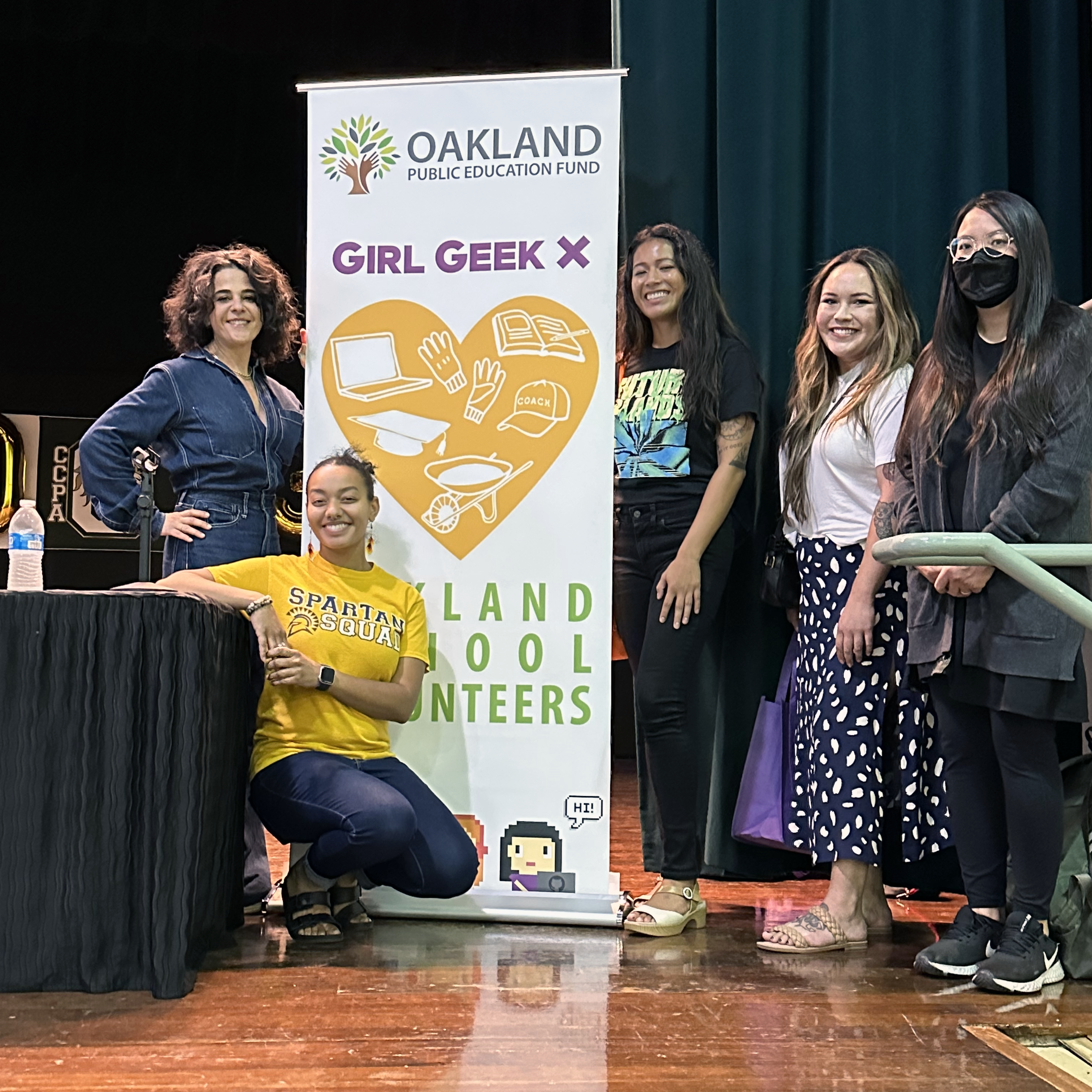
And we have a participation leaderboard going today. So you’ll be rewarded for what is it, putting little emojis in people’s sessions, cheering them on, messaging each other, asking questions. So please show our speakers some love during their session. You can also schedule meetings with fellow attendees in this air meet software by using the attendees search bar to browse profiles or click on someone’s name in the chat or at a table in the mentorship lounge. And at the end of the event, the top three folks on our leadership board will get a Girl Geek X swag bag of cool stuff. So if you’re one of our top participants today, you get really cool stuff, so encourage you to participate. One of the things that we did in the pandemic when education was disruptive is we began volunteering with the East Oakland School in partnership with a nonprofit called the Oakland Public Education Fund.

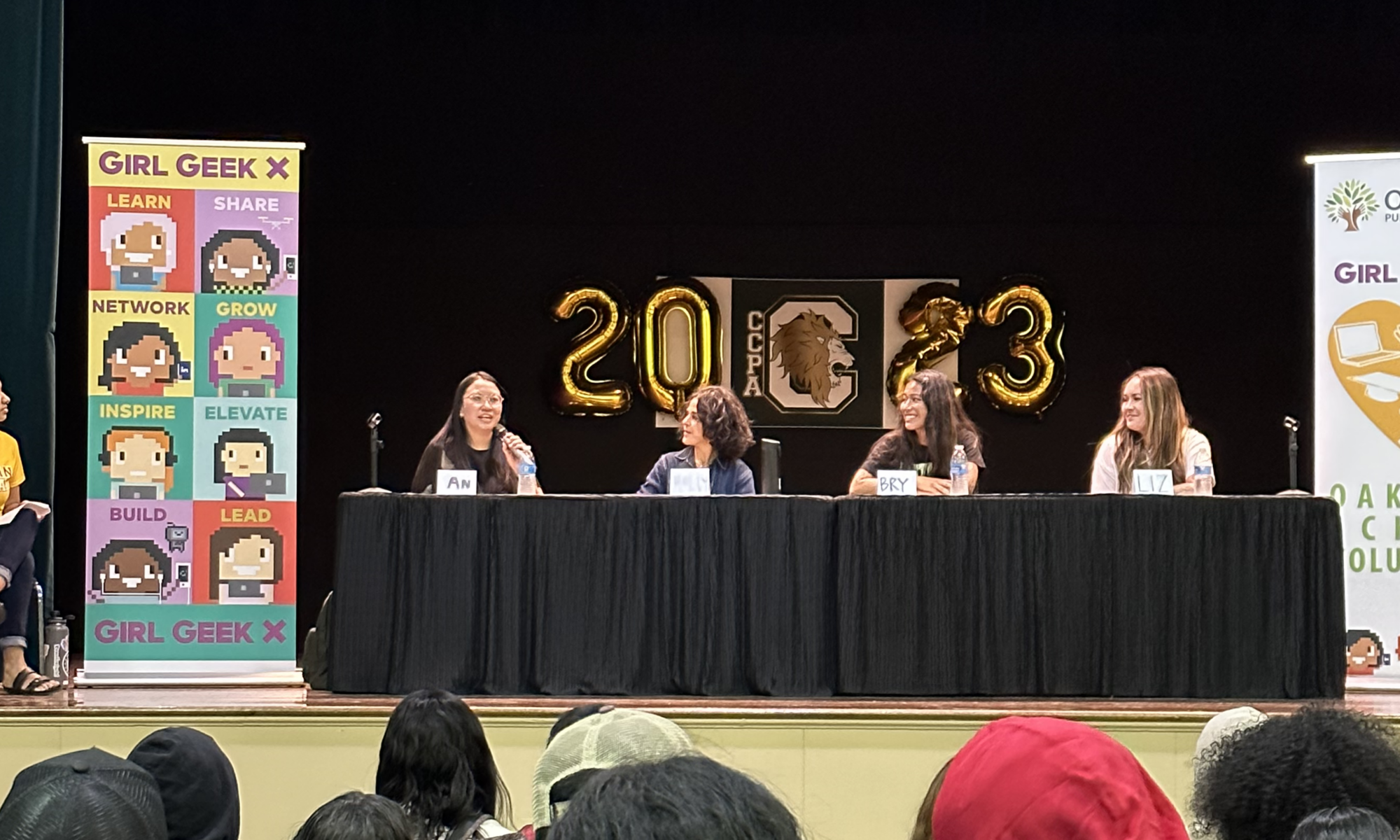
And if you happen to be in the area, you can join us in Oakland or you can sign up to volunteer through Tech Link, which is a virtual or hybrid mentorship program with the East Oakland Public School. It happens Fridays in February through April, and as I said, it’s virtual but with the option to go in if you would like to, and you can sign up for that and find out more about that at our website @girlgeek.io or in our weekly newsletter. And this is the third year that we’re partnering with this nonprofit to bring our professional network of women and allies to the local schools to provide a helping hand for educators and introduce students to role models. As you know, probably in our lives we didn’t have that great role model working in tech to meet us when we were in high school or junior high school. So it’s really a great opportunity to help be that role model that you always wanted in your life. And if given our current economic climate, if you know someone who’s looking for a job, we do have some job listings at our website @girlGeek.io/jobs. There’s a diverse set of remote and hybrid roles from some of our partners this year. I’m going to hand it over to Amanda.

Amanda Beaty: Hi, my name is Amanda Beaty and obviously I’m used to being in the background here at Girl Geek X. I do things like social media and working on YouTube videos. Our co-founder Sukrutha is usually here in this spot, but she’s unable to join us today, so I’m filling in. Today we will be hearing from a diverse set of women working in tech from executives to individual contributors. We love hearing from women about their unique expertise and inspiring stories, all the cold job titles and incredible passions and values. Hopefully our speakers will inspire you to do that hard thing that you wanted to do or help you think differently about something. We’ll be learning so much today and we encourage you to help us amplify and elevate the incredible takeaways our speakers will be sharing with us today. If you want to share on social media, please tag Girl Geek X and use the hashtag #ElevateWomen.

All of our talks are recorded and put on our YouTube channel later. You can also immediately hit replay in this air Meet platform after the session ends, so you can re-watch this later today or later this week. So if you’re interested in speaking, 95% of our speakers today submitted speaker submissions on the Girl Geek X website to speak here today. You can go to our website, girlgeek.io and go to the speak at the top of the menu and just click apply to speak at an upcoming Elevate conference. Our next one is in March on International Women’s Day, and then we’re doing this quarterly for the rest of the year.

So we’re also looking for sponsors who are hiring women in tech to partner with us to showcase their top leaders and talent to put more technical women leaders on stage and create more role models. If your company is invested in hiring diverse female talent, come visit us in the booth later today that Angie mentioned earlier. And now Angie’s going to introduce our keynote speaker for the day.

Angie Chang: Yes, so our keynote speaker today is Lakecia Gunter. She is the chief technology officer for the Global Partner Solutions Organization at Microsoft. GPS is the largest partner ecosystem in the industry, empowering partners to drive digital tech transformation. And prior to joining Microsoft, she held several leadership roles at Intel Corporation, including technical assistant and chief of staff to the CEO, as well as vice president in the Programmable Solutions group. You may remember her from Intel Girl Geek dinner in 20 27, 20 17, and today we are excited to welcome our keynote speaker. Welcome.

Lakecia Gunter: Thank you Angie and team. “You may write me down in history with your bitter twisted lies. You may trod me in the very dirt, but still like dust, I’ll rise. Does my sassiness upset you? Why are you be set with gloom? Because I walk like I got oil wells pumping in my living room? Just like moons and like suns with a certainty of tithes, just like hope springing high still I’ll rise. Did you want to see me broken, bowed head and lowered eyes, shoulders falling down like teardrops weaken by my soulful cries. Does my hotness offend you? Don’t you take it awful hard because I laugh like I’ve got goldmines digging in my own backyard. You may shoot me with your words, you may cut me with your eyes, you may kill me with your hatefulness, but still like air, I’ll rise.”

I love this poem by Maya Angelou. It is one of my absolute favorites, and if you’re like me, when you hear this poem, you imagine, no you remember the obstacles that stand in the way of women rising. It can be so difficult at times. In fact, I often reflect on my own journey and think you should not be here because the odds of becoming a vice president at Intel, a CTO at Microsoft and a corporate board of directors member at IDEX Corporation seemed insurmountable. But as Maya says, “still, I rise. Still, you rise. Still, we rise.” My intention today is to inspire you to think about the ways you can be a force for blazing a trail for sisters around you and those coming behind you so that as we are leading, as we’re moving forward, as we are rising together, we can lift others to rise with us to lift as we climb.

Good morning. I’m Lakecia Gunter, as Angie said, and I am so elated to be here with you this morning. I don’t take this opportunity lightly to connect with amazing women in this room, in this virtual environment on this call. It’s an absolute pleasure and as Angie said, I’m no stranger to the girl Geek community. I love the Girl Geek community. It’s so empowering and supportive of women. So Angie, thank you. Thank you to you and your team for your passion, for your focus on increasing the number of women leading at the highest levels in tech. My hope is that one day very soon, the rooms in the tech industry will be overflowing with women and I believe with each of us working together, we’re going to make that happen. There’s no doubt about it in my mind. I cannot believe it, but we’re less than 30 days away from 2024?

Can you believe this ladies? 2023 has flown by, I don’t know about you, but I’m determined to make 2024 my most transformational year yet. How many of you guys agree our most transformational year yet? No matter what you faced in 2023, we know at times, it can be so challenging, but remember, you are resilient. You are an overcomer. I want you to know that there’s no obstacle, no setback, no mountain that can prevent you from dreaming those big dreams and achieving what others may think is impossible. And when we support one another, we are an unstoppable force. I know this firsthand because I’ve experienced this in my life. If I’ve done anything right along this journey, it’s been connecting with the right people at the right time, building strong supportive networks, supportive relationships has really been the key to my success. It’s what I call my secret sauce.

I’m excited today to really just kind of walk you through my story and my journey into tech and my journey absolutely began in a small town in Florida. Yes, a small town in Florida called Hane City. It’s right outside of Orlando. Our claim to fame was being one of the top producers of the most delicious oranges in the state and being right next door to all those theme parks that we love to visit in Orlando, like Walt Disney, universal and the likes. I was raised by a strong and equally amazing single mom of three who had a heart of gold age, supportive grandparents and a phenomenal family and a community that really looked after its own. I was surrounded by faith, love, strength, and unity. My mom instilled in me the value of hard work. She set an example of how to stay vigilant in the face of adversity, never allowing challenges, which they came in life or in the environment to dictate how her life story would be defined, and she made certain that it wouldn’t take mine early in life.

I discovered my love for computers and I have to tell you, my mom certainly encouraged me. One year, she worked extremely hard to make certain that I could get a computer. She worked extra shifts to make sure I could buy my very first computer for Christmas or she could buy my very first computer for Christmas, let me just say that it was her buddy, but it was a Commodore 64. I know I’m taking some of you guys way, way back. How many of you guys remember the Commodore of Vic 20, the Commodore of 64? Am I by myself in this Ataris? You remember ladies, but that was one of the best Christmases I’ve ever had. My mom was my biggest cheerleader and she never missed an opportunity to show me. She always invested in me in my future, equipping me with the resources, the tools to achieve my wildest dreams.

That was my mom. I love this quote by Marilyn Monroe. It says, “Give a girl. Give a girl the shoes….” Excuse me. “Give the girl right shoes, and she will conquer the world.” And in my case, it was more like give the girl the right computer and she will conquer and travel the world, and I did. For me, age 12 was just the beginning. I never could have predicted what was coming next. It has been a whirlwind. I had been so extremely blessed with a phenomenal career and the opportunity to work for so many different companies. That deep love for computers would take me from that small town in Florida to some of the top universities in the country, University of South Florida, in Tampa to Georgia Tech and provide me with the opportunity to work with some of the best companies on the planet, top Fortune 100 companies I’ve been able to work for in my career.

As Andrew said earlier, currently I’m at Microsoft. Like some of you though, my very first job was at KFC. How many of you guys remember that fast food experience? Was it just me? I don’t think so. That’s where I got my start. Mr. And Mrs. Tinsley, entrepreneurs in my hometown, African-American entrepreneurs at that they owned the franchises and one of them was a KFC. They spotted my promise as a young team, and hired me as a lobby hostess at age 14. I had my first job making my own money. By the time I was a senior in high school, I was assistant manager, working with my peers, working with my classmates, I was making my own money and contributing to my family’s success. There was no greater feeling than that. This opportunity was so meaningful to me. It really made a huge difference in my life and the life of my family, and this was my very first experience of being lifted up.

As I reflect on my career journey, there’ve been several people that made a huge difference in my career. And on the screen, you see a couple of them, these leaders really invested in me and I know that my career journey and any success that I’ve achieved has really been because of these men and women who believed in me. They invested in me, they empowered me to pursue my dreams and goals. More importantly, they put themselves in my shoes and remembered what it was like when they first got started in their life and in career. And as I said earlier, being in tech can really be hard without the support of community, including managers and senior leaders. I know for me, one can feel very alone in Fortune 50 companies with over a hundred thousand employees with very few women and people of color. I want to highlight three leaders who changed my life and career trajectory.

The first Bob Swan, former CFO and CEO of Intel. Bob was always a huge support for me in my career. As Angie said, I had an opportunity to be chief of staff and technical assistant to Brian Krzanish, the former CEO of Intel. And Bob was CFO at the time and I would never forget, he always made me feel like a leader on the team, like a part of the management committee. One time I put together a leadership offsite and it was a two-day offsite and it was just a lot of great work around strategy, team building and the likes, and we were done. It was the end of the day, we’re actually in the jet center about to head back to Santa Clara and he came up and he put his arm around me and he said, Lakecia, you make us better. Wow, that touched me so deeply in my heart I felt like, wow, he sees me.

I’m adding value to the team. I will never forget that moment in my career ever. And Bob continued to be a major supporter for me in my career. So much so that when I was interviewing for him for a board opportunity with Idexx, he was one of my references and he was so excited to be a reference for me. He said, Lakecia, I just talked to Igon Zender and let me just tell you, you’ve got this, so proud of you. It’s a done deal. And of course I did get the board seat, and so he’s continued to be a shining light, a bright light, a mentor, a sponsor, even until today. He saw me, he recognized my value, he recognized my impact, and he has continued to enable my growth and my success. I’m so grateful for that. The second picture is Rodney Clark. Rodney recruited me from Intel to join Microsoft.

And what I loved about that opportunity is that he said, “Lakecia, not only am I hiring you for a job, I’m really sponsoring you into a career at Microsoft.” That meant the world to me. It wasn’t that, hey, I’m just looking for someone to fill a spot. No, I’m looking for someone that can grow their career at Microsoft and someone who I believe has a long trajectory at Microsoft. So grateful for Rodney. Every year he made certain that I was growing. He made certain that I had new opportunities with bigger scope. He believed in me and my potential to achieve at the highest levels. Such an amazing leader, so empowering, one of the best. And last but certainly not least, the beautiful face on the slide is Pamela Lusardi, affectionately, we called her Pete. Pete hired me into Intel in 2008. She was a 27-year Intel veteran and a phenomenal leader.

She believed in me from day one ladies, she told me, so Lakecia, you and I we’re going to change the world of of silicon validation of intel. No doubt about it. We’re going to be the dynamic duo. The first few days on the job, she said to me, Lakecia, you have to make this a hundred thousand person monstrosity at Intel seem like a family. You’re going to have to. You need to make sure you create that very small, tight-knit community or more importantly, she said, you won’t make it because that’s been her experience. She said, “I want to help you build your Intel family.” So let me tell you what she did. The first few days on the job, she said, “You’re going to kill this job. I’m not worried about that.” But she gave me her Fab five or her fave five, whichever you want to call it.

She gave me five women in her network to go and meet. She truly embodied the #Liftherup. She is me. I am her. That’s what Pete did the first week on the job. She absolutely had a vision for my career. There was no doubt about it. We met every week, strategize for the week ahead, put our game plan together. We were just in lockstep making changes in validation, changes that were really well received. And one of my weekly one-on-one conversations after I had been on the job for about six months at this time, it was March 31st, 2009, I’ll never forget, she began to share a vision for my career at Intel. She said, “You can become a technical assistant and chief of staff for one of Intel’s c-suite leaders.” My first thought was, wow, this is awesome. And my second thought is, but what is that?

I had no clue at the time, I’d only been in the company for six months. I had no idea. She said, also, you can become one of Intel’s rock stars and I’m going to help you do both. Ladies, let me tell you, I was in tears in the room. I never actually cried in front of my manager, but I was in tears because I’m like, wow. I never had a leader see me that way and I never had a leader tell me, here’s where your future is and here’s where I’m going to get you to together. We’re going to do it. Not only was Pete a smart, beautiful country girl, she loved family, she loved farming and she loved animals. Dob Lewis was one of her charities that she absolutely enjoyed serving and spending time and donating her dollars to. And guess what? She was a licensed pilot.

She owned her own plane. She loved flying and many times she would actually fly her plane to work. Yes, my boss flew her plane to work. She would park it in the Hillsborough airport hangar right down the street from Intel and she would ride her bike to the office. She was so cool. I called her a pint-sized powerhouse. We adored Pete. On April 1st, 2009, the next day after our one-on-one again the night before, she shared with me her plan for my career and what we were going to do together.. The next day, what was April fools day, I’ll never forget, we actually got news that we were not prepared for. Pete’s plane had crashed on the way to work.

I remember looking for her that morning. She was supposed to be in the cafeteria with her manager and it had been raining that day, very rainy. And so we thought, well, she doesn’t fly her plane in the rain, so she’s probably driving. She was a little bit late, but unfortunately her manager confirmed that on the way to work, her plane had crashed. I lost my career best manager at that time. And so Pete’s impact on my life has been phenomenal, is tremendous. There isn’t a day that doesn’t go by that I don’t think about her and what I learned from her in those short six months. And so I dedicate this talk to her. I really do. She absolutely was amazing. And as I said, one of the most important things that she told me to do when I first started at Intel is to make sure that I build my network.

And so Pete’s wisdom continues to resonate with me. I know she attributed her success at Intel to not just hard work but the power of her network. And I’m forever grateful to her for extending her network to me. She was giving me access to women who could help me, who would provide guidance and insight to help me navigate my career. Women who shared their experience, their resources and their relationships to help me accelerate my success. Her fab Five supported me and encouraged me during one of the most difficult times in my life. They helped me to actually achieve the dreams and visions she set out for me to become a chief of staff and technical assistant to a c-suite leader at Intel. I was so proud to be able to realize the things that she had planned, not just for me but the entire team.

She wanted us to be an award-winning software development team at Intel. And of course we achieved that in three years. Again, Pete encouraged me to develop those trusting relationships that help support and encourage you on your career path through every step of your journey. That’s what we want to make sure that we’re doing. Something as personal as dreaming truly starts with the relationships that you make. And as you heard me say, in my case it did. I didn’t have a dream to be a chief of staff and technical assistant, but she had that for me and that enabled me to realize that dream. And so I continued to expand on everything that she taught me about building my network and making sure that my team was growing. And as you can see on the screen… Yes, as you can see on the screen, I continued to expand my network and I continued to expand my network to make sure it absolutely even included male allies.

That was just as important. I continued to grow that network. People that are a part of my network made certain that whatever I needed they could provide and whatever they needed, I could provide as well. All of these people have shown up for me in so many ways. And the same can happen for you. This is what I call my Team Lakecia, my squad, my personal board of directors, my personal board of advisors. It is truly an interconnected network of mutually supportive relationships that Elevate not just my capability but the capability of the entire network. You too can build your team. And we’re going to talk about exactly how to do that.

In a recent survey, 88% of women surveyed said they absolutely wanted to advance to the next level. 70% have a desire to be a senior leader. But many times when we’re presented with opportunities, women, we say women typically say no. We let fear stop us from pursuing our desires. I have fallen victim to this a couple of times. You see the beautiful picture on the slide, that’s Mary Wilner, she’s the vice president at Intel. And Mary and I connected a number of years back. I heard her speak and she was amazing and immediately said, I need to know her. I want to learn more about her story. I want to learn how she achieved at the highest levels. And Mary willingly spent time with me in one-on-ones. And over the course of some time, I shared with her that I was looking for my next opportunity.

And so she would always send me different roles across Intel that may have come her way. And on this one particular occasion, she actually had a couple roles that were available in her organization and she was so excited to share those with me. She sent them to me an email and said, hey, let’s get some time together. Lakecia, I want to talk to you about these opportunities. I think one of them may absolutely be right up your alley. And so I had a one-on-one with Mary. We talked about the role. Well, even before I met her, I thought mmh, this looks quite interesting. Although I’m not sure I have everything on the list, but I’m still going to have the conversation with Mary. So I went in, I had the conversation, we had a good time chatting, and so she began to outline what she was looking for in the role and then she also even went as far as to say, here’s where I think you’ve got tremendous strength in the role and your skillset.

And so we continued the dialogue and I said, well, thank you so much for thinking of me, but as I look at this, I only have 7 of the 10 items that you’re looking for. And so she said, Lakecia, don’t you ever do that again? Surely you have strengths for this role, but there may be some gaps, but that’s okay. You can go learn those things along the way. And she said, you know what? I sit with men all the time and I’ve never had a man tell me he wasn’t qualified for their job. Even if he thought he had one of those items, he would say, I’m in. I got this. And so my point I,s many times we say no because we’re afraid to fail or we are afraid to succeed in some cases. I have learned to say yes, actually I can.

And I learned that from the conversation I had with Mary. Because you know what, we’ve got a certain set of qualifications and skills that really enable us to do any job and wherever we may have gaps, my idea was you know what, call your team Lakecia, and just say, you know what? I told Mary I can do this job. I have no idea how I’m going to do it. I even got the job. I don’t know how I’m going to do it. And they’ll help you get prepared. So I’m being facetious a little bit, but the point I’m making is say yes to opportunity. We’ll figure out the next steps to close any gaps or perceived gaps that you may think that you have. So what am I saying, ladies? I’m saying today it’s a new day. It really is a new day. It’s time to transform our thinking altogether.

It’s time to really realize that you know what, our dreams are on the other side of fear. So in 2024, we’re going to render fear powerless. We’re going to make sure that fear no longer has a control over us. I always say, look, fear directly in the eyes and say, hello, I see you, but we’re going to move past it. We’re going to feel it. We’re going to use it. We’re going to operate through it. Fear really isn’t an obstacle, but it’s an opportunity. An opportunity for us, for you, to uncover the next best thing or even the path to achieve your dreams and goals. If you want to live your best life now, allow yourself to experience more fear. When you do this, you open yourself up to the unknown and it can be mind-blowing everything you want. Everything you desire is on the other side of fear, so it’s time to face everything and rise.

Let’s begin to access our courage and live boldly into the greatness that we all are capable of. In 2024, we’re transforming. We are absolutely going to cancel self-doubt. That’s exactly what we’re going to do, ladies. It no longer has any place in our future. We’re going to not entertain it at all for me, and I know we’ve all had those moments of self-doubt. I can recount numerous times where I’ve doubted my ability and my capability. Like maybe when I was overlooked for a promotion several times. At that point, I decided to open up my aperture to new opportunities across the company and even externally. I said, you know what? It may be time to go where you’re valued. Or when I was standing at doors of new opportunity, that doubt started to creep in and I really kind of felt like an imposter. But I called my team Lakecia and they said, “Girl, you are a super bad sister, you’re up for this challenge. We got you.” I’m like, you’re right. I could do this. Self-doubt can creep in when people speak over you and interrupt you in meetings.

I’m sure I’m not the only one. I’m reminded of Vice President Kamala Harris when she said, “I am speaking and I say, I am speaking.” Or when those voices say that you’re not enough, maybe at the end of the day where you’re thinking about tomorrow, and sometimes those little voices, those old tapes start to play and say, you know what? You’re not enough. But I remind myself, you know what girl, you have graduated from Georgia Tech. You worked in some of the top Fortune 500 companies. You are all that in a bag of chips. Whatever that self-talk is for you, we have to make sure that we’re playing those positive tapes in our mind. It is truly time for each of us to be the hero of our own story, our own lives, and cancel self-doubt in 2024, we’re going to do this together.

No doubt about it. And when you do that, you’re getting yourself ready to roar in 2024. That’s what I’m talking about. Roaring in 2024 so that you can soar in 2024. I started a podcast a few years ago, not necessarily willingly, but one of my coaches said, “Lakecia, I think it’s a great thing for you to do. You should start a podcast.” I’m like, well, okay. And it absolutely was the best thing I could have ever done. I have the opportunity to talk to Fortune 50 business and tech executives and women leaders about the hidden power that’s inside of us as women. It’s a fire that’s in all of us, and we talk about how often that fire is suppressed by fear. Well, I’m here today to tell you ladies that this power is your birthright. It’s your roar and it’s waiting to be unleashed.

As you can see, ROAR stands for reflection. In 2024, it’s time to clarify your vision, believe in your potential, begin to reflect on your own wins. You are a winner, and whatever you do next, you’re going to win at that too. Opportunity, sit in your power and say yes to opportunity. Don’t say no. Say yes, actually I can. And then begin to phone a friend and say, let’s put our strategy together so that I can really knock it out of the park when I start my new job. Action, it’s about tapping into your network, articulating what the right next steps are and running towards the thing that you might be afraid of because that one thing could unlock so many new opportunities. Relationships, we’ve talked about pulling together your board of directors, your board of advisors. Begin to assemble that team and make sure that you become a part of someone else’s.

Ladies, it is time to release your ROAR. Get ready. I love this quote by MLK. He says, “Life’s most persistent and urgent question is, what are you doing for others?” Well, we can answer that question. Let’s answer this question by elevating and empowering women in industry and becoming a part of their personal board of directors, because you and I both know that behind every successful woman is a tribe of other successful women and male allies who have their back, and let’s make sure that we’re also paying it forward. On this slide, you should see four beautiful women on this slide. They’re absolutely amazing women. They’re rock stars and they’re dear friends of mine. I love this tribe that you see on the slide. We support each other, we mentor, we sponsor. We’re sounding boards. I wear their T-shirts and rooms that I’m in and they wear mine.

It’s been an honor to play a small role in their career success. As I said, these are super bad women. They’re total rock stars. Kelly on the left hand side is a new VP at Isotope. We work together at Intel. Diane is a VP at Lululemon. We worked together at Microsoft and she was an amazing partner to me and really enabled my success in so many ways. Phenomenal sounding board. Panya is a senior director at Meta. We’ve been friends for over 25 years. Phenomenal leader, Paan Diane are a part of Black Woman on board Rising program and just kicking butt, taking names. Karenga, the last picture you see as a senior director at Intel, I was part of her recruiting process into Intel. I hired her into my org and I promoted her. It was a well-deserved promotion and she earned it even before I hired my organization, we’re making this happen.

I also sponsored her into a leadership program for IWF. She had an opportunity to meet phenomenal women across the world, go to Harvard. Again, it is important that we are lifting as we climb, that we’re supporting other women through their career journey. So my question to you today is who will you lift up? Who will you put in those circles? What four women will you put in those circles on the screen? Who will you open doors for? It’s so fun to be able to do that. And the next thing I want to ask you is who will you add to your team? Who is going to be part of your personal board of directors, your personal board of advisors? Who are you going to make sure you can support them and they can support you? Build your team, build your squad, build your personal board of directors. It’s so important as Pete said to me from day one. It’s to build that community of supporters. It starts today, and I’m here to help you in any way that I can.

Now ladies, I want us to really imagine the lift that we will see as a group. If all 1000 plus attendees at this conference take the actions I just outlined in the next few days. Imagine the beautiful mosaic we can create in corporate America when we’re intentional about lifting each other up. If everyone lifts up one more woman, the tables and the rooms and the C-suites will look so different. Imagine the difference we can make by lifting others up and calling on our squads to lift us.

Imagine the strength we will create collectively as women lifting women. Just like moon and suns with the certainty of tides. Just like hope springing high, still, we rise. Thank you, thank you, thank you. Thank you for the opportunity to spend time with you guys today. It’s been my absolute pleasure to be a part of this conversation. Thank you Angie and team for including me in this amazing conference. Let’s start the movement. Lift her up, lift as you climb. We’re going to fear less and roar more. We’re going to roar with Lakecia Gunter. Thank you so much for this opportunity. It’s been an absolute pleasure to be with you today. Angie, thank you.

Angie Chang: Thank you so much for that inspiring talk. I learned so much from your slides about your team, your stories of inspiration, of receiving sponsorship, and also the encouragement for women to sponsor others. So that’s a really great call out. We have a lot of people chatting away. I don’t know if you want to take a question?

Lakecia Gunter: Yeah, happy to take some questions. My pleasure, thank you.

Angie Chang: Two minutes left in this session.

Julia: Hello? I’m here waiting for something, I don’t know what I was waiting for. I do have a question. First off, thank you so much for such a strong… I’ve just been sitting here just watching with just awe.

Thank you so much. Oh, actually, let me show my face if I can. There we go, hello.

Lakecia Gunter: Hi, Julia.

Julia: Hi. So yeah, I’ve just been sitting here like this the whole time. Yes, thank you so much. This was a phenomenal talk. And I guess my question is, I am currently trying to build my squad. We’re trying to roll. And so how do you know somebody is for the squad? Because not everybody’s for the squad. And so I’m trying to build quality squad here. And do you have any tips on building that squad, finding the people to get into that squad and stuff like that? Thanks.

Lakecia Gunter: That’s a great question, Julia.

Angie Chang: One minute. Sorry. Just a reminder, we’re going to end in one minute. So yeah.

Lakecia Gunter: One minute, okay, I’ll be very quick. Thank you. We’re right at 9:39. So what I would say is, for instance, Mary Wilder became a part of my squad, the picture that I’ve shown in terms of the job opportunities, because she was speaking and I was so inspired by her talk. I simply said, I walked up to her and I said, hey, I love to get to know you. A few years in my career at Intel, you are super successful. I’d love to learn from you. And so we had a one-on-one. I always just ask people for 15 minutes and that 15 minute coffee chat, we began to connect on so many things.

She was from Florida, I was from Florida. She was Cuban American, I’m African American, we both were engineers. And so we just began to find those common trait dialogue. And once we did that, she became part of team Lakecia. So it’s about finding connection. So as you begin to meet people, you’ll know, and they all know that, you know what, we want to be connected. We’re forever friends. Mary has retired from Intel. We’re still friends. I had her on my podcast. So it’ll come to you as you begin to connect with people, you’ll find those natural connections, and that will be a person who’s willing to be a part of your team Julia. Thank you for the question.

Julia: One quick follow up. What’s your podcast? I think other people ask that too.

Lakecia Gunter: Sure, it’s Roar with Lakecia Gunter. I’m so sorry. So yeah, you can find me on Apple, Spotify, Roar with Lakecia Gunter. I’m putting it in the chat. If you search on that on Google, my podcast will come up. And I’m working on season two as we speak. It’s been a phenomenal experience for me. I’ve learned so much by doing the podcast. Thank you so much.

Julia: Thank you.

Lakecia Gunter: All right, thanks ladies.

Julia: Thank you.

Lakecia Gunter: Bye.
Best of Girl Geek X on YouTube!

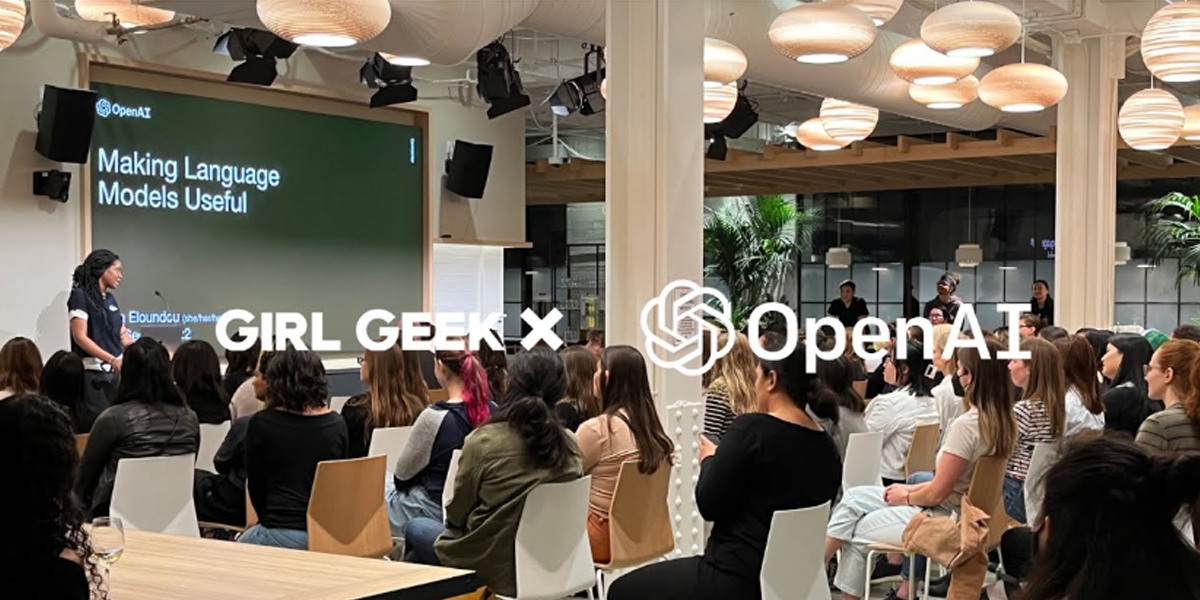
girl geek x openai Tyna Eloundou
After hosting 250 Girl Geek Dinners and ELEVATE Virtual Conferences in celebration of International Women’s Day for thousands of women around the world.Here are the most watched 10 videos from Girl Geek X YouTube! You can watch (or re-watch) them at the links below:

  1. Girl Geek X OpenAI Lightning Talks – Christine McLeavey, OpenAI Member of Technical Staff, Alethea Power, OpenAI Member of Technical Staff, Tyna Eloundou, OpenAI Member of Policy Staff
  2. Prompt Design & Engineering for GPT-3 – Ashley Pilipiszyn, OpenAI Technical Director
  3. Girl Geek X OpenAI Lightning Talks & Panel Brooke Chan, OpenAI Software Engineer, Lilian Weng, OpenAI Research Scientist, Christine Payne, OpenAI Research Scientist, Mira Murati, OpenAI RL Team Manager, Amanda Askell, OpenAI Research Scientist
  4. Ensuring artificial general intelligence (AGI) benefits all of humanity – Mira Murati, OpenAI RL Team Manager
  5. You’re a Sales What? Life as a Sales Engineer Melissa Andrews, Splunk Sales Engineering Manager
  6. Using reinforcement learning (RL) to learn dexterous in hand manipulation policies – Lilian Weng, OpenAI Research Scientist
  7. Scale your career with open source: Girl Geek X Confluent Talks & Panel – Neha Narkhede, Confluent Co-Founder, Bret Scofield, Confluent UX Research, Elizabeth Bennett, Confluent Software Engineer, Priya Shivakumar, Confluent Senior Director of Product Marketing
  8. Leading through change & embracing the mess – Anu Bharadwaj, Atlassian VP of Product
  9. Fireside Chat with Neha Narkhede, Board Director & Co-Founder of Confluent Neha Narkhede, Confluent Co-Founder
  10. “Thank u, next: How ‘diversity’ gets in the way of gender equity” Aubrey Blanche, Atlassian Global Head of Diversity & Belonging

sponsorshp

Best of Winter ELEVATE 2023: From Building Your Network To ROAR Into 2024, To Passing Your Systems Design Interview – And Applying To ALL THE JOBS!

girl geek x elevate winter conference speakers speaking women in tech

Girl Geek X’s highly-anticipated WINTER ELEVATE Virtual Conference on December 6, 2023 hosted over 1,000 mid-to-senior women in tech around the world online for inspiration, mentorship, and networking.

Thank you to our 88 speakers & mentors for helping make ELEVATE conference an incredible experience. Check out special packages from Formation & ApplyAll!

Here are the most popular talks from December 6th’s ELEVATE 2023! You can watch (or re-watch) them at the links below:

  1. Lift Her UP: It is time to ROAR into 2024 (Keynote) Lakecia Gunter, Chief Technology Officer, Global Partner Solutions at Microsoft
     
  2. How To Pass Your Systems Design Interview – Sophie Novati, CEO & Founder at Formation
     
  3. Framework for Strategic Personal GrowthLiliya Sabitova at TikTok
     
  4. Supercharge Your Resume: 5 Tips to Get More InterviewsTal Flanchraych, CEO & Founder at ApplyAll
     
  5. Thinking Like A Designer: Strategies to Shine in Today’s Job Hunt Olivia Ouyang, Product Designer at Finix
     
  6. Combining Math, Art, & Tech: Roles in Data VisualizationMichelle Maraj, Senior Business Intelligence Manager at Gigpro

  7. Effective Tech Leads Empower Developers to Ship Projects Faster with Higher QualityDominique Simoneau-Ritchie, Chief Technology Officer at Affinity
     
  8. Next-Gen Solutions: Leveraging AI for Smarter Security Risk DecisionsNas Hajia, Security Architect at Autodesk
     
  9. Speak to Impress: Elevator Pitch and Crafting ImpactHana Rasheed, Senior Engineering Program Manager at Adobe
     
  10. AI Product Management for the “Enterprise Consumer” – Savita Kini, Director of Product Management, Speech & Video AI at Cisco
     
airmeet mentorship lounge elevate virtual conference girl geek x tables dec

68 Mentors kicked off the conference by volunteering in the Mentor Lounge buzzing with questions and advice on everything from engineering to product, from interviewing to career search tips.

Mentors joined from companies like Amazon, Autodesk, Blue Shield, Gap, Google, Intuit, Salesforce, Sweetgreen, WP Engine and more. Mentors ranged from CTO to engineering managers, VPs to senior engineers, product and non-coding roles in tech.

elevate dec speakers
If your company is looking to recruit more women this year, please don’t let them miss out on our next Virtual Conference & Career Fair sponsorship opportunity! 

We want to hear from you. The next ELEVATE Virtual Conference is March 8, 2024. We also partner with companies monthly on Girl Geek Dinners in the San Francisco Bay Area.

Please email sponsors@girlgeek.io and we’ll be in touch.

Thank you in advance!

– Angie Chang, Sukrutha Bhadouria, Amy Weicker, Amanda Beaty and the team at Girl Geek X
 
girl geek x elevate winter conference speakers speaking women in tech
https://girlgeek.io/mentorship-lounge-elevate-virtual-conference-december-6-2023/
elevate career fair dates

Become a sponsor of ELEVATE 2024 VIRTUAL CONFERENCE & CAREER FAIR!

Mentorship Lounge Sessions – ELEVATE Virtual Conference (Dec. 6th, 2023) – Morning and Afternoon!

https://girlgeek.io/mentorship-lounge-elevate-virtual-conference-december-6-2023/


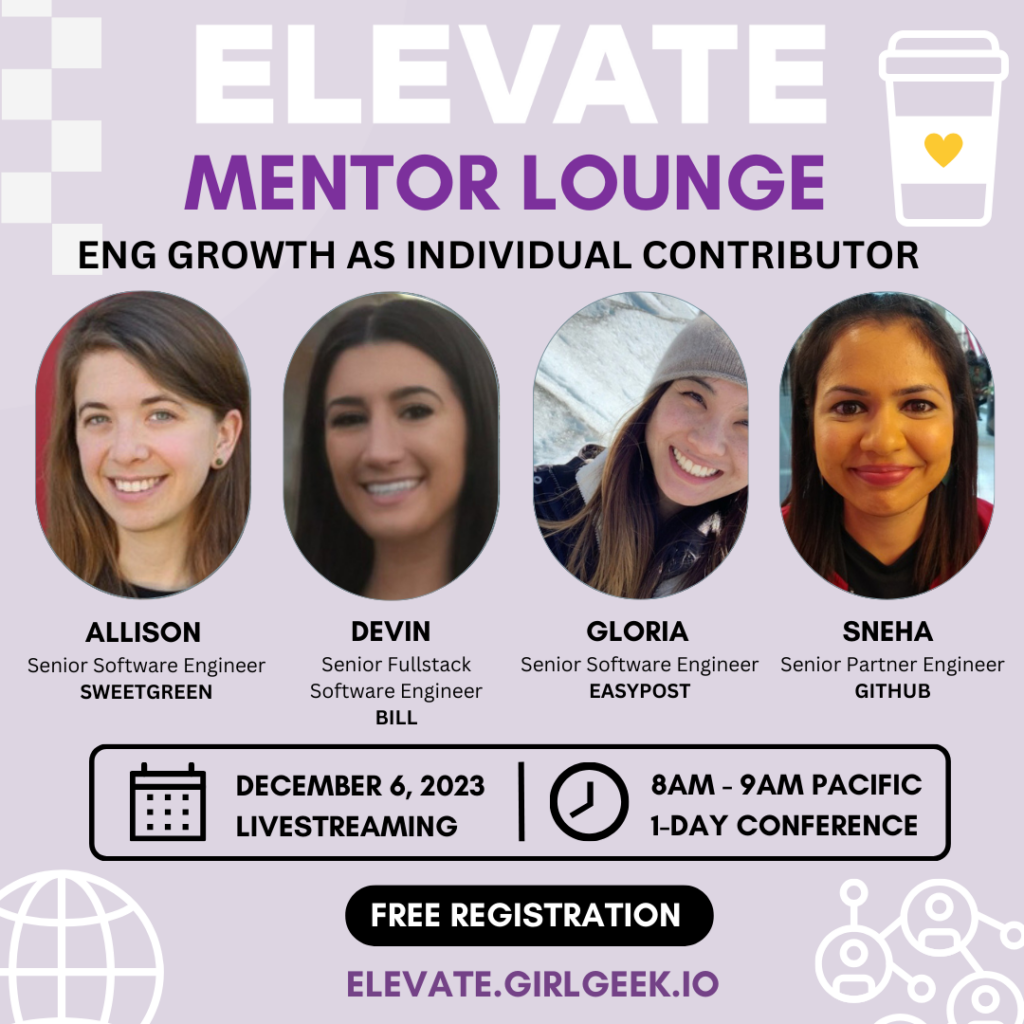
Table #1 – Eng Growth as Individual Contributor – Mentors:

8AM-9AM Pacific – Table Topics: Interviewing, Negotiation Leadership, Career Changers, Promotions, Growth, Breaking Barriers as a Woman in Engineering, Breaking Into Tech, Bringing Your Authentic Self to Work, Startups, Women in Engineering, Backend Development, Full Stack Development, Product Development, Angular / React, Typescript, Java

Elevate Mentor Table Eng Growth am Allison Colyer Devin Nicholson Gloria Chen Sneha Natekar

Eng Grow As IC Mentors: Allison Colyer (Senior Software Engineer, Sweetgreen), Devin Nicholson (Senior Full Stack Engineer, BILL), Gloria Chen (Senior Software Engineer, EasyPost), Sneha Natekar (Senior Partner Engineer, GitHub)


Table #2 – Product Management – Mentors:

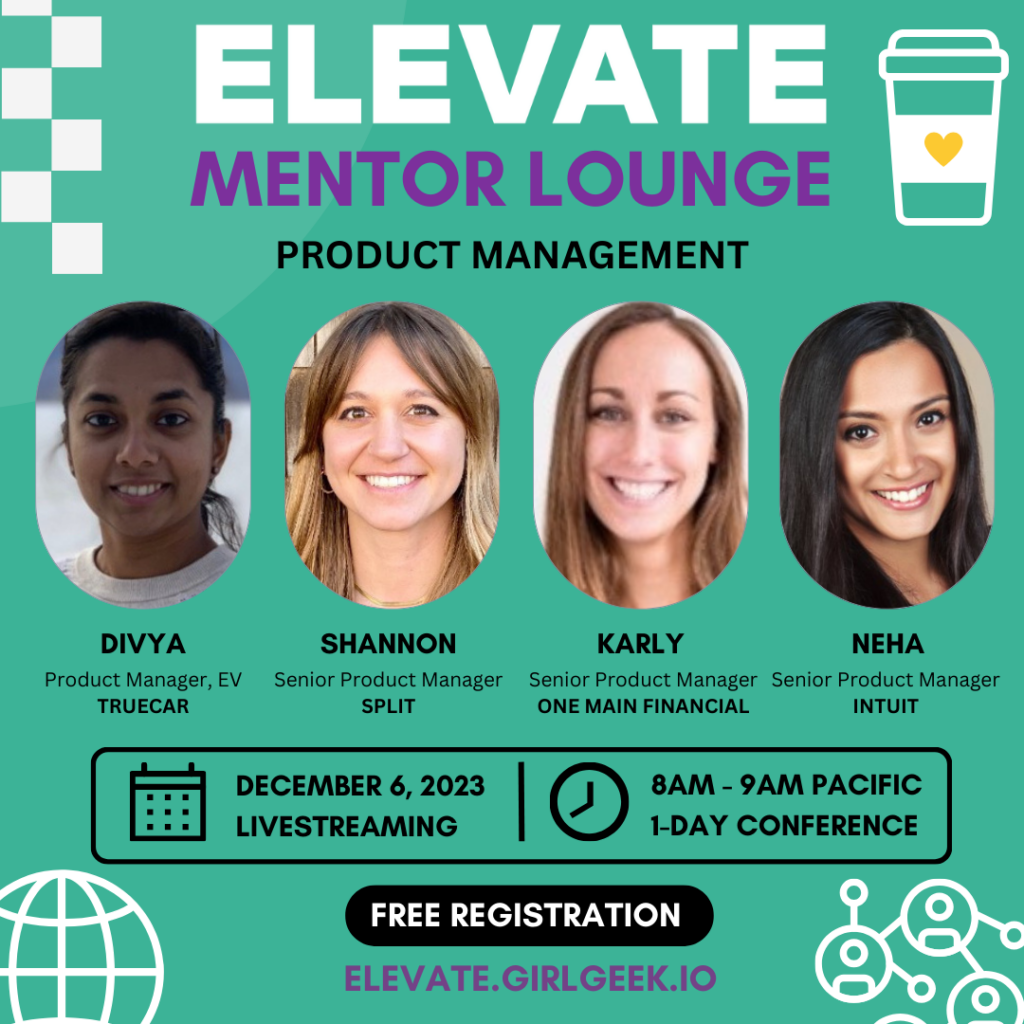
8AM-9AM Pacific – Table Topics: Getting Into Product Management, Transitioning from Systems Engineering to Product Management, Searching For PM Job in the US Without Work Experience / Degree in Country, SaaS or B2C Product Management, Career Transition to Product, Transition to Fintech, Assimilating to a Tech Culture from Growing Up in a Blue Collar Life, Working on H1-B, Cross Functional Collaboration, Communicating for Impact

Elevate Mentor Table Product am Divya Prabakar Shannon Cassidy Karly Bolger Neha Dobhal

Product Management Mentors: Divya Prabakar (Product Manager, Electric Vehicle Growth, TrueCar), Shannon Cassidy (Senior Product Manager, Split), Karly Bolger (Senior Product Manager, One Main Financial), Neha Dobhal (Senior Product Manager, Intuit)


Table #3 – Program Mgmt & Engineering Mgmt – Mentors:

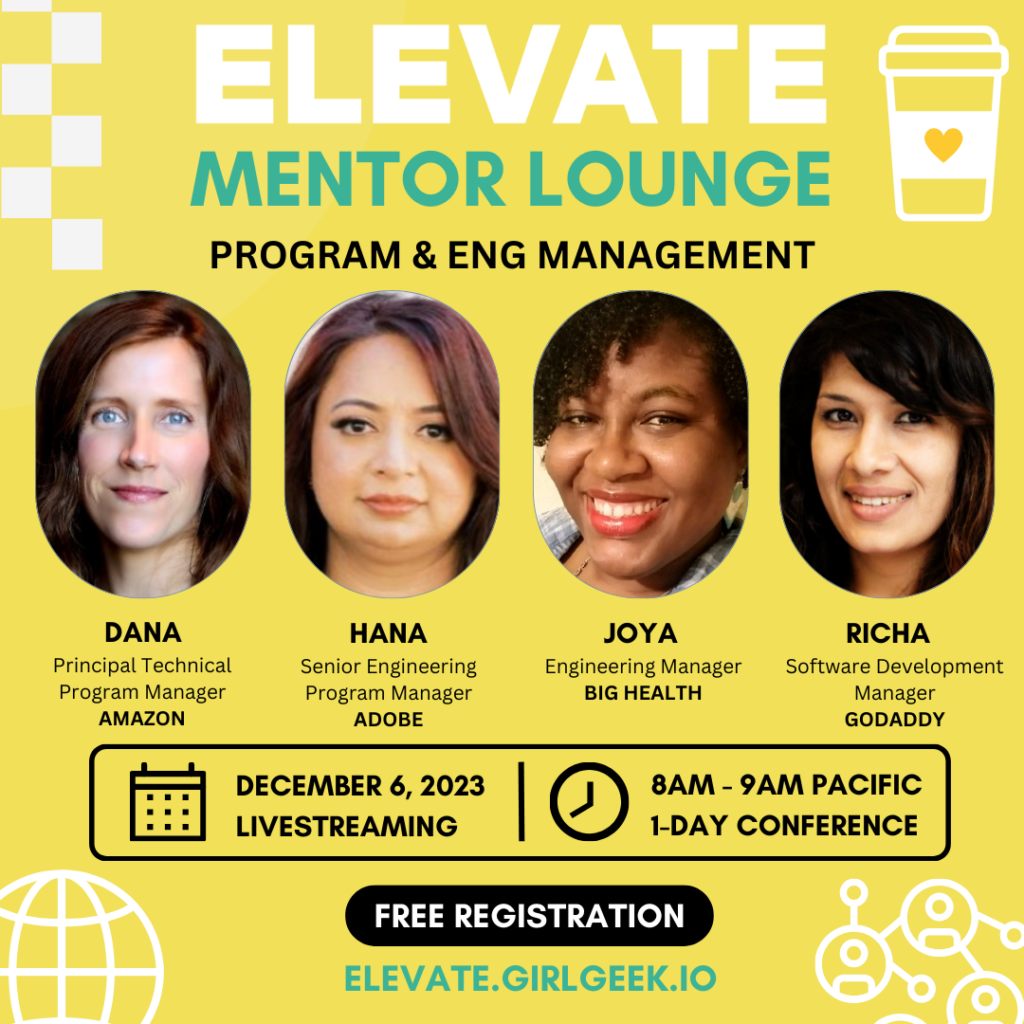
8AM-9AM Pacific – Table Topics: Career Journey Support, Navigating Challenging Situations, Salary Negotiation, LinkedIn Branding, Networking Skills, How to Build Your Elevator Pitch, Career, Burnout, Communication, Leadership, Self Worth, Early Career Advice, Transitioning from IC to Management

Elevate Mentor Table Program Mgmt Eng Mgmt am Dana Stodgel Hana Rasheed Joya Joseph Richa Gandhi

Program Mgmt & Engineering Mgmt Mentors: Dana Stodgel (Principal Technical Program Manager, Amazon), Hana Rasheed (Senior Engineering Program Manager, Virtualization, Data Analytics & Office of CIO, Adobe), Joya Joseph (Engineering Manager, Big Health), Richa Gandhi (Software Development Manager, GoDaddy)


Table #4 – Non-Coding Roles in Tech – Mentors:

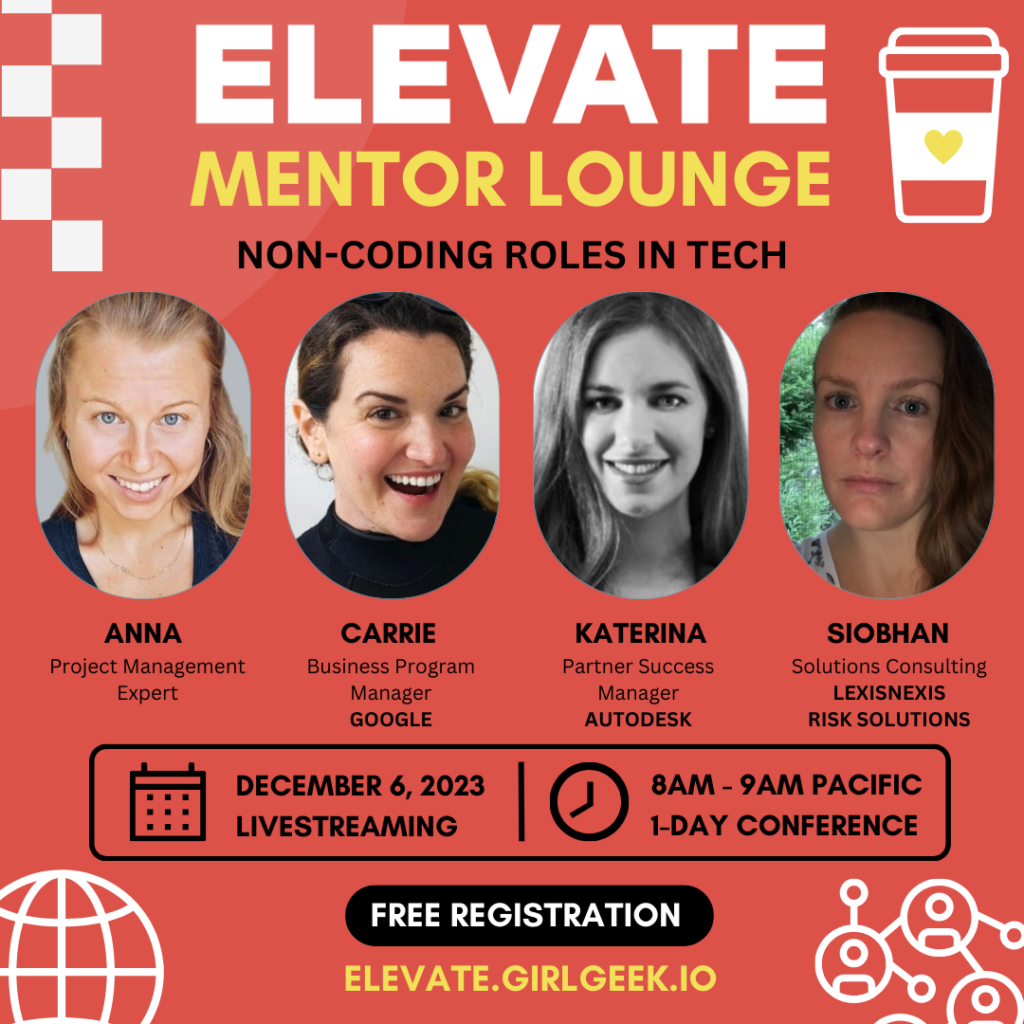
8AM-9AM Pacific – Table Topics: Project Management, Transition to Tech, Career Transition, ADHD / Neurodiversity, Non-Traditional Backgrounds, Mental Health Advocacy, Customer Success, Personal Growth, Speaking Up, CareerJourneys, Teaching Non-Technical People Technical Ideas

Elevate Mentor Table non coding roles in tech am Anna Konovalova Carrie Browde Katerina Papadimitriou Siobhan Dolen

Non-Coding Roles in Tech Mentors: Anna Konovalova (Project Management Expert), Carrie Browde (Business Program Manager, Google), Katerina Papadimitriou (Partner Success Manager, Autodesk), Siobhan Dolen (Solutions Consulting, LexisNexis Risk Solutions)


Table #5 – Career Development / Promotion – Mentors:

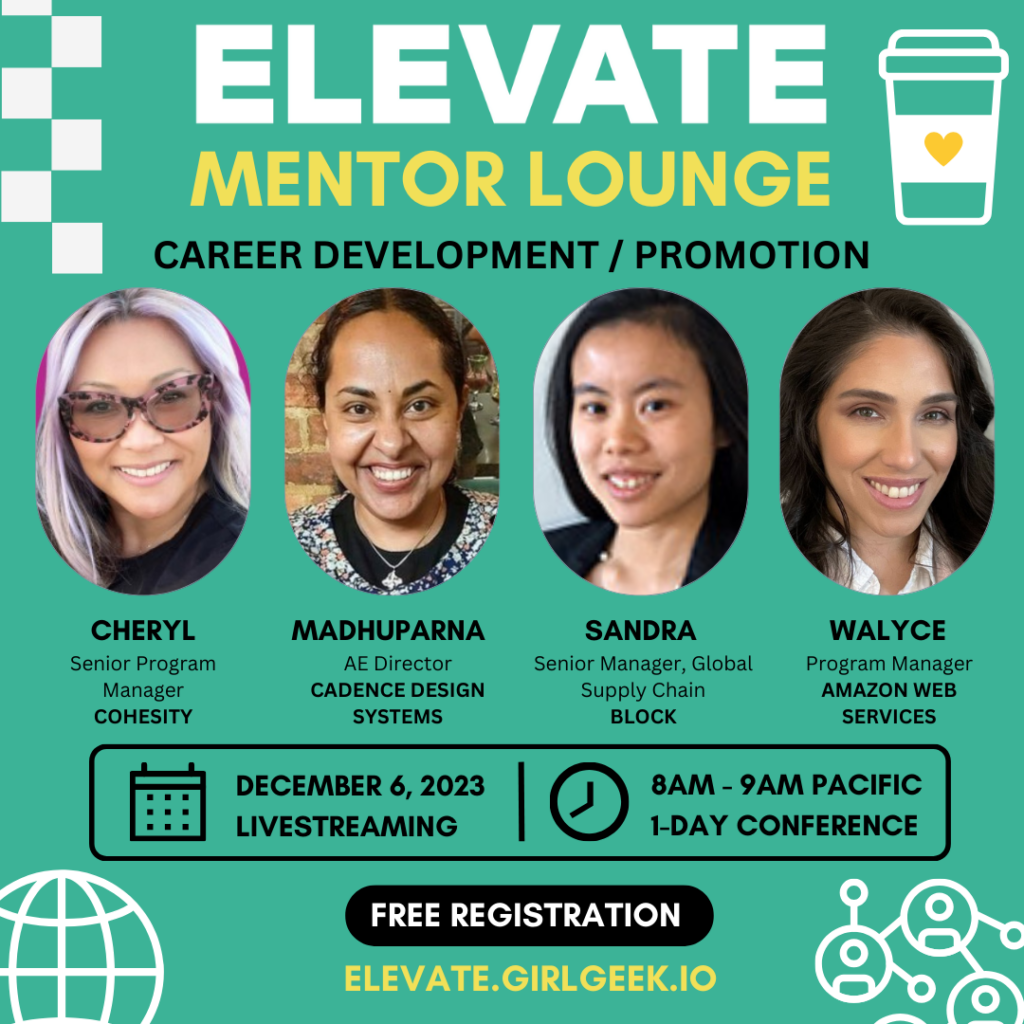
8AM – 9AM Table Topics: Career Advancement, Bringing Your Authentic Self to Work, Mastering Technical Depth versus Breadth, Mind Mapping Your Career, Art of Authentic Networking, Mentorship versus Sponsorship, Supply Chain / Operations, Manufacturing, Product Development, Leading Teams, Managing Distributed Workforce, Career Ladders, Hiring / Recruiting, Project Management, Performance Management, Mentoring Resources, Money Management, Women in STEM, Career Transition from Journalism to Tech, Building a Team, Digital Project Management, First-Gen American

Elevate Mentor Table am Cheryl Marquez Madhuparna Datta Sandra Chen Walyce Almeida

Career Development / Promotion Mentors: Cheryl Marquez (Senior Program Manager, Cohesity), Madhuparna Datta (AE Director, Cadence Design Systems), Sandra Chen (Senior Manager, Global Supply Chain, Block), Walyce Almeida (Program Manager, Amazon Web Services)


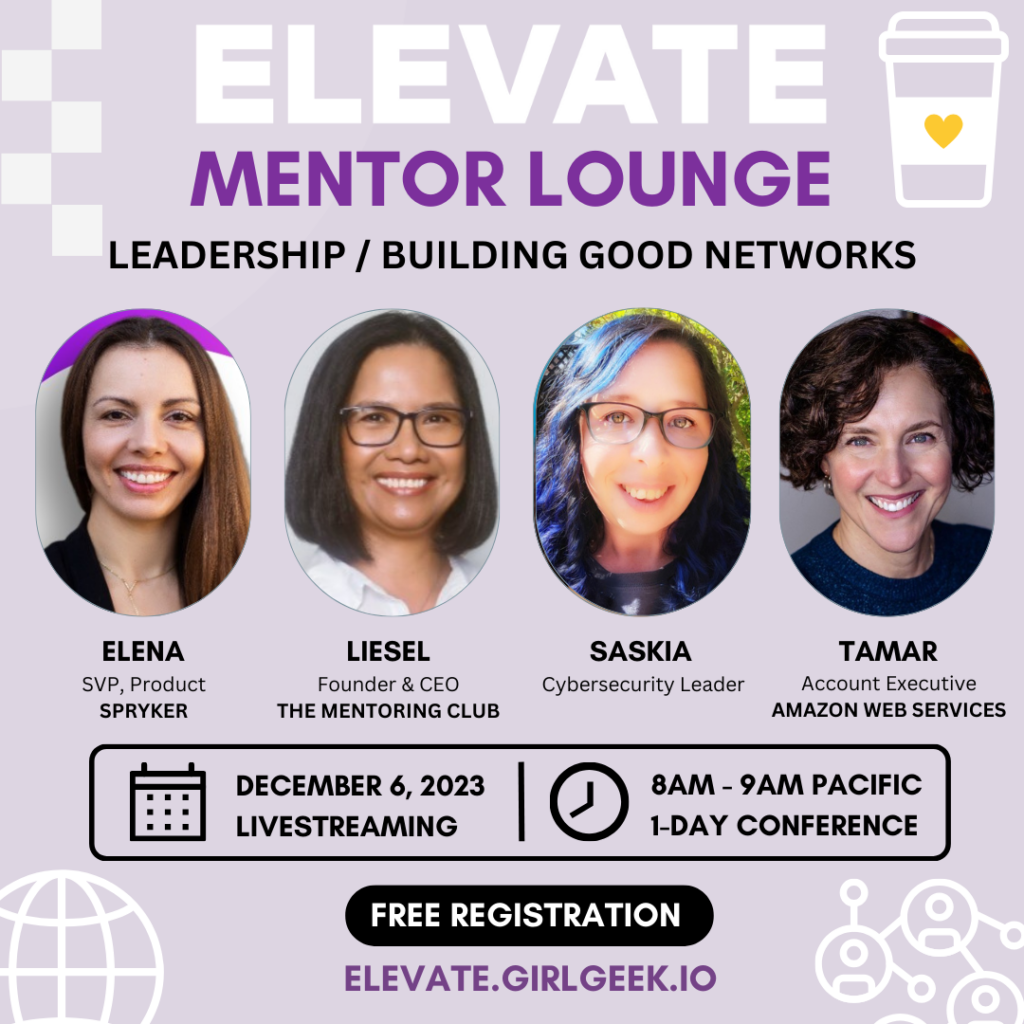
Table #6 – Leadership / Building Good Networks – Mentors:

8AM- 9AM Table Topics: Leadership, Career Planning, Career Development, Executive Presence, Communication, Networking, Product Management, Cyber Security, Job Searching, Startup Lessons Learned, Building your Reputation Inside and Outside of Your Organization, Paying it Forward

Elevate Mentor Table Leadership Good Networks am Elena Leonova Liesel Mendoza Saskia Hoffman Tamar Bobys

Leadership / Building Good Networks Mentors: Elena Leonova (SVP, Product Management, Spryker), Liesel Mendoza (Founder & CEO, The Mentoring Club), Saskia Hoffmann (Cybersecurity Leader), Tamar Bobys (Account Executive, Amazon Web Services)


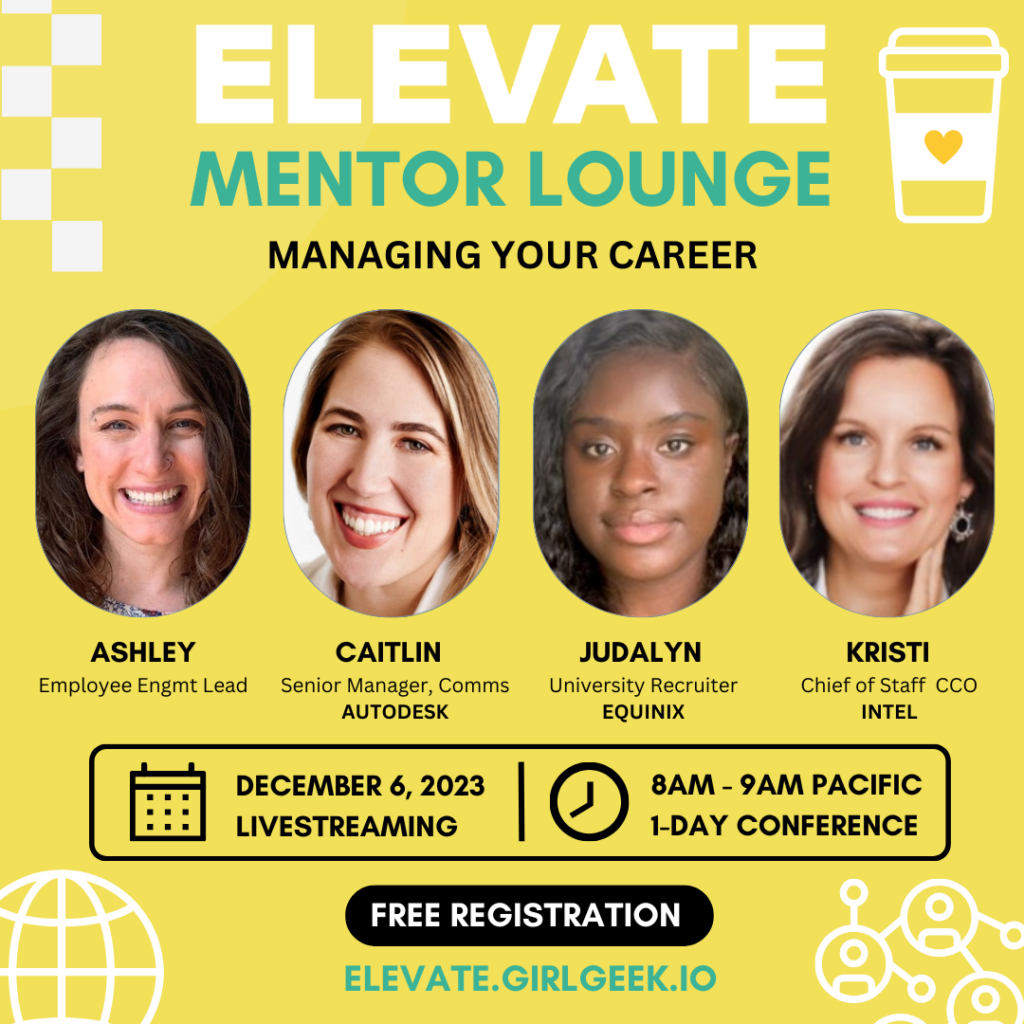
Table #7 – Managing Your Career – Mentors:

8AM- 9AM Table Topics: People Operations, Leadership, Navigating Difficult Conversations, Working In / Around Bureaucracy, Communication, Personal Branding, Non-Technical Jobs, Career Progression, Job Opportunities, Imposter Syndrome, Building Career Roadmaps, Interviewing, Assessing Next Steps, Negotiation, Communicating Effectively

Elevate Mentor Table Managing Your Career am Ashley Wichman Caitlin Anderson Judalyn Kristi Allen ()


Managing Your Career Mentors: Ashley Wichman (Employee Engagement Lead), Caitlin Anderson (Senior Manager, Internal Communications, Autodesk), Judalyn A. (University Recruiter, Equinix), Kristi Allen (Chief of Staff to Chief Communications Officer, Intel)


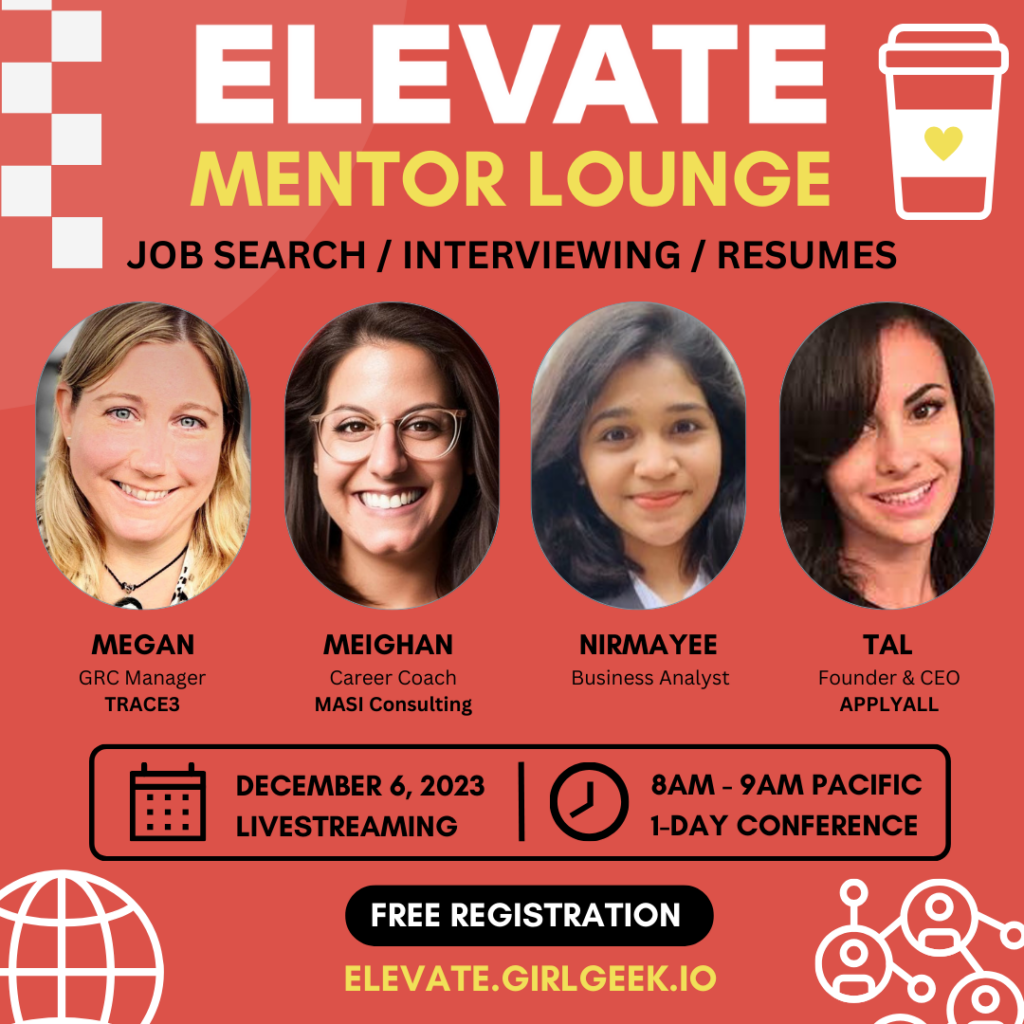
Table #8 – Job Search / Interviewing / Resumes – Mentors:

8AM- 9AM Table Topics: Navigating a Terrible Job Market, Interview Tips, Resume, ATS Parsing, Online Profile, Overcoming Imposter Syndrome Career Transitions, Cybersecurity

Elevate Mentor Table jJob Search Interviewng Resumes am Megan Guth Meighan Agosta Nrmayee Dighe Tal Flanchraych


Job Search / Interviewing / Resume Mentors: Megan Guth (GRC Manager, Trace3), Meighan Agosta (UX Researcher / Career Coach, MASI Consulting), Nirmayee Dighe (Business Analyst), Tal Flanchraych (Founder & CEO, ApplyAll)


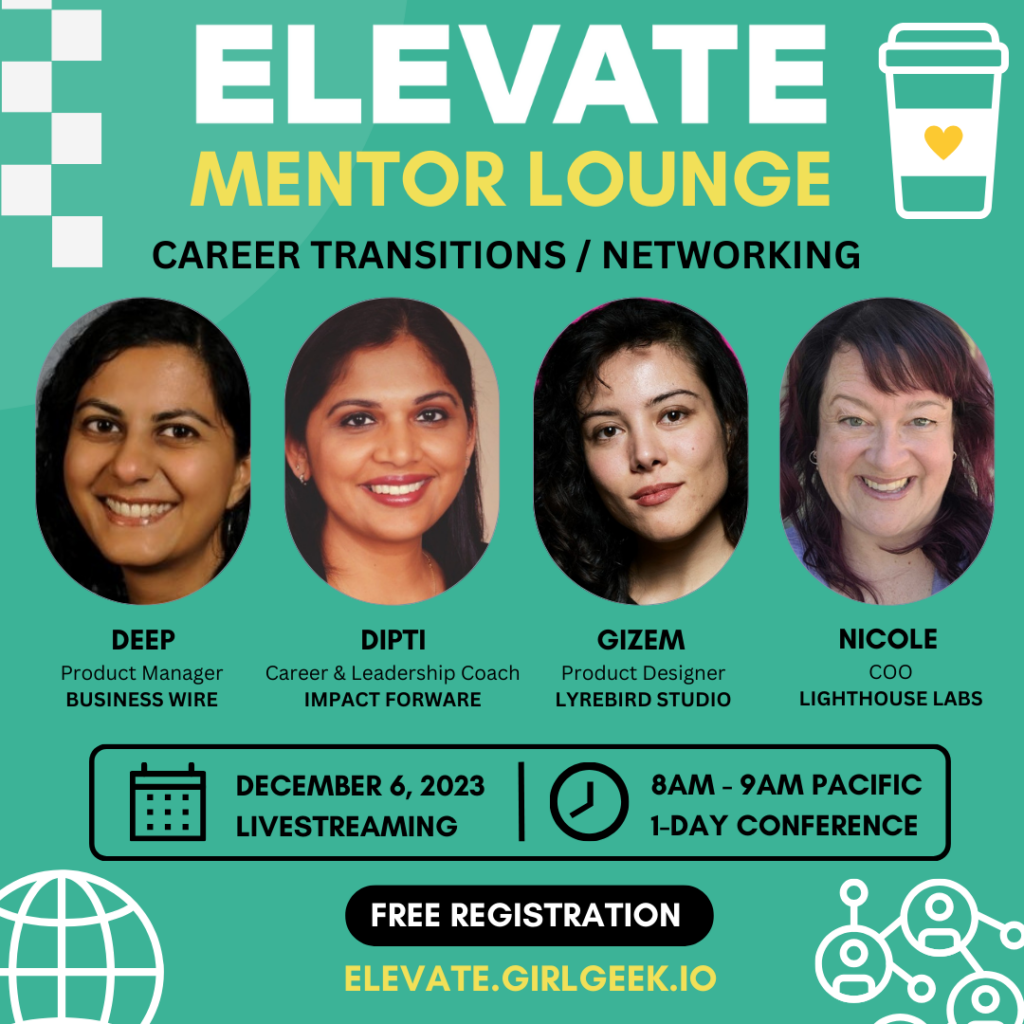
Table #9 – Career Transitions / Networking – Mentors:

8AM- 9AM Table Topics: Career Transitions, Career Transitions into Tech or Senior Leadership Roles, Career Mapping, Building Relationships, Avoiding Getting Fired, Product Management, Product Strategy, Influential Communication

Elevate Mentor Table Career Transition am Deep Rastogi Dipti Patel Gizem Kaymakci Nicole Hussain


Career Transition Mentors: Deep Rastogi (Product Manager, Business Wire), Dipti Patel (Career & Leadership Coach, Impact Forward), Gizem Kaymakçı (Product Designer, Lyrebird Studio), Nicole Husain (COO, Lighthouse Labs)


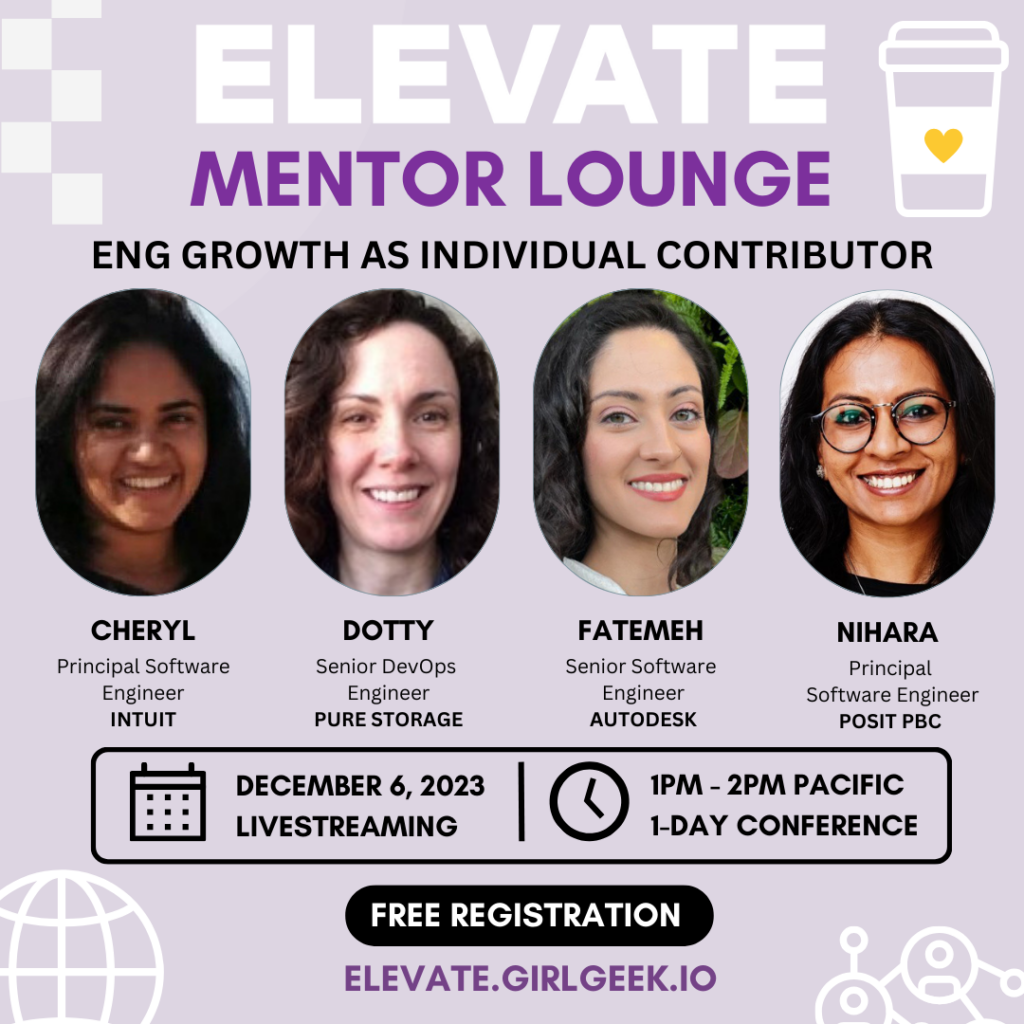
Table #1 – Eng Growth as Individual Contributor – Mentors:

1PM- 2PM Table Topics: Individual Contributor Career Growth, Switching Technology as Software Professional and Advancing, Mobile Development, Self-Promotion, Work / Life Balance, Importance of Networking, Empowering Young Professionals & Women in Tech, Career Paths, Interviewing, Negotiating, Technical Learning Paths / Opportunities, Backend Engineering

Elevate Mentor Table Engineering Growth As Individual Contributor pm Cheryl Aranha Dotty Nordberg Fatemeh Saremi Nihara Thomas


Eng Growth as IC Mentors: Cheryl Aranha (Principal Software Engineer, Intuit), Dotty Nordberg (Senior DevOps Engineer, Pure Storage), Fatemeh Saremi (Senior Software Engineer, Autodesk), Nihara Thomas (Principal Software Engineer, Posit PBC)


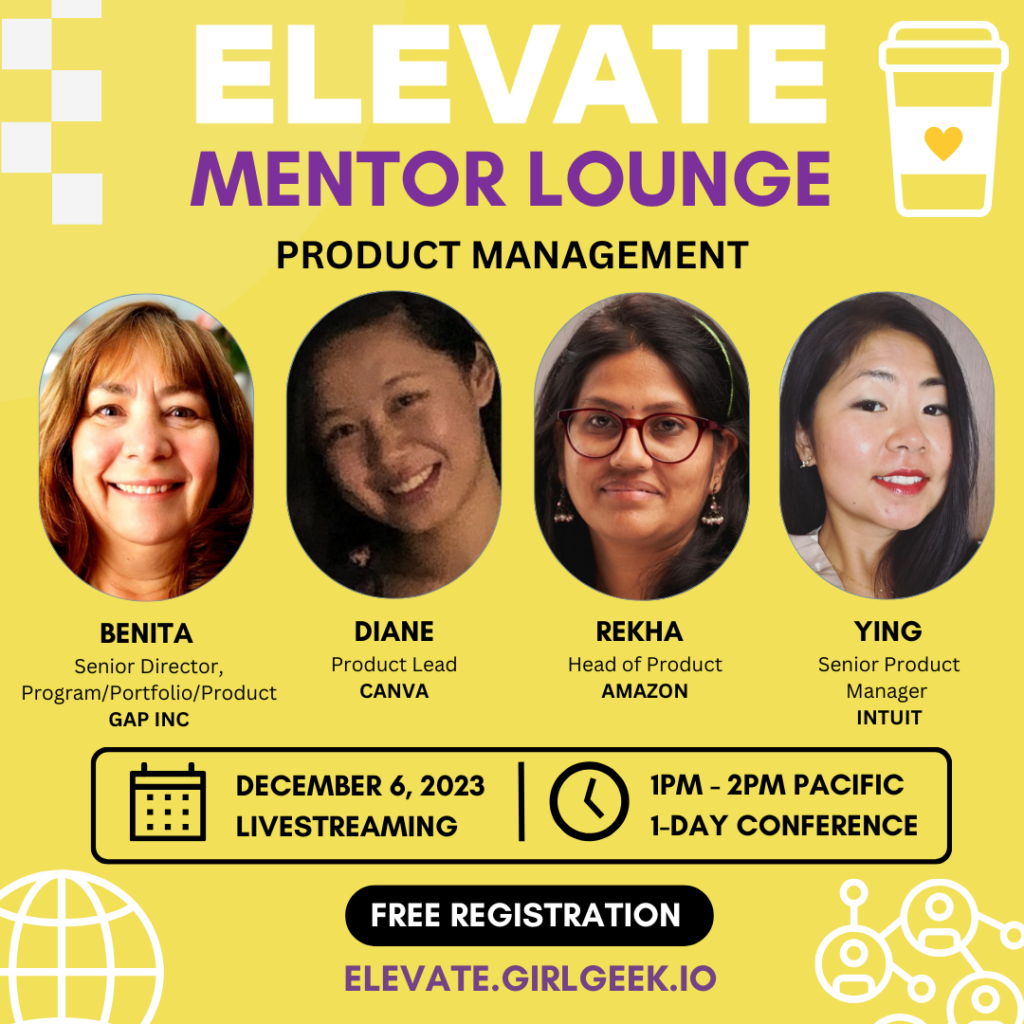
Table #2 – Product Management – Mentors:

1PM- 2PM Table Topics: Program / Project Management, Product Management, Leadership Roles, Paving your Path as a Woman in Tech / PM, Navigating Early Career for New Grads or Students, How to Support and Rally Each Other to Cultivate a Diverse Workplace, Navigating Internal Mobility, Setting Strategy / Vision, NLP / ChatBots, Future with AI

Elevate Mentor Table Product Management pm Benita Bankson Diane Huang Rekha Venkatakrishnan Ying Ge


Product Management Mentors: Benita Bankson (Senior Director, Program / Portfolio / Product Management, Gap Inc.), Diane Huang (Product Lead, Canva), Rekha Venkatakrishnan (Head of Product, Amazon), Ying Ge (Senior Product Manager, Intuit)


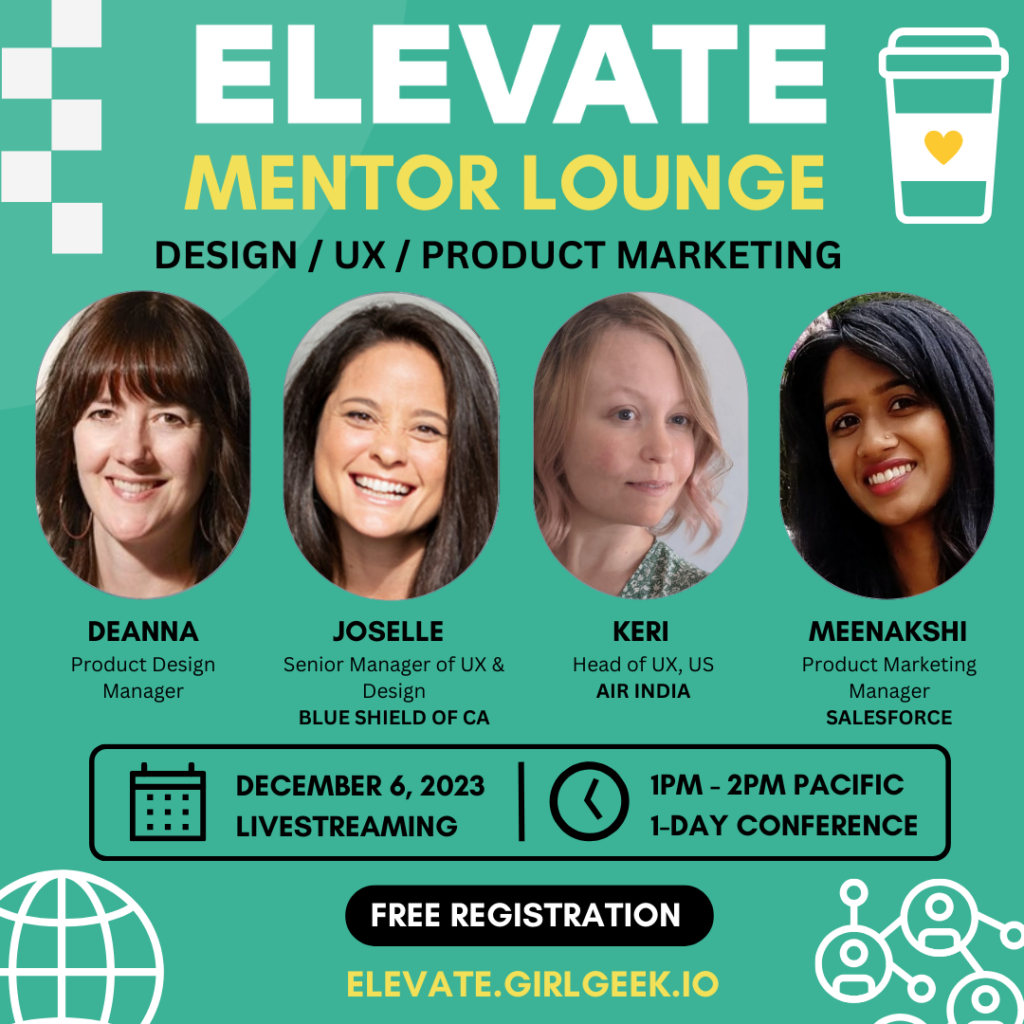
Table #3 – Design / UX / PMM – Mentors:

1PM- 2PM Table Topics: Fostering Team Culture, Career Development, Upleveling, Product / UX Design, Design Process, UX Research, Cross-Functional Collaboration, Performance Management, Innovation, Healthcare, Startups, Fundraising / Investment Decks, Design, Leadership, Business Career Growth, Product Marketing, Public Speaking

Elevate Mentor Table Design UX Product Marketing pm Deanna Alcorn Joselle Ho Keri Fullwood Meenakshi Ganesh


Design / UX / Product Marketing Mentors: Deanna Alcorn (Product Design Manager), Joselle Ho (Senior Manager, UX & Design, Blue Shield of California), Keri Ashton Fullwood (Head of UX, US, Air India), Meenakshi Ganesh (Product Marketing Manager, Salesforce)


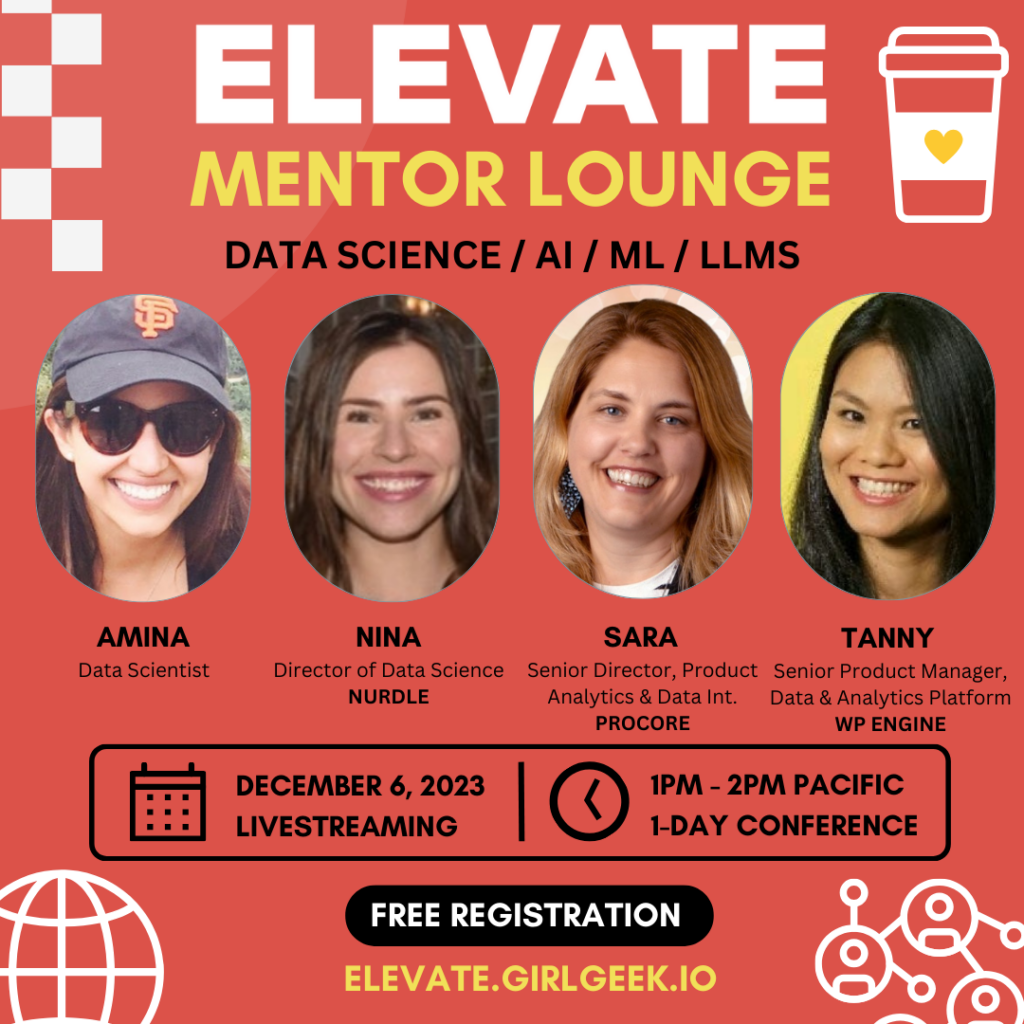
Table #4 – Data Science / AI / ML / LLM – Mentors:

1PM – 2PM Table Topics: All Parts of the Data Pipeline (Collection, Curation, Analytics), Product Based on Data, Data Science, Machine Learning, NLP, LLMs, Management, Balancing Family & Tech Career, Analytics, Leadership, Transition from IC to Manager, Seamless Products at the Intersection of People / Data / Efficiency

Elevate Mentor Table Data Science AI ML LLMs pm Amina Penoff Nina Lopatina Sara Wetzler Tanny Ng


Data Science / AI / ML / LLM Mentors: Amina Penoff (Data Scientist), Nina Lopatina (Director of Data Science, Nurdle), Sara Wetzler (Senior Director, Product Analytics & Data Intelligence, Procore Technologies), Tanny Ng (Senior Product Manager, Data & Analytics Platform, WP Engine)


Table #5 – Leadership in Tech – Mentors:

1PM – 2PM Table Topics: Team Building, Leadership, Management, Quality Engineering, Hiring, Program Management, Technical Program Management, Tech for Social Good, Technical Leadership, Entry-Level Roles, Promotions, Total Comp Negotiations, Career Progression, Executive Presence, Navigating Conflict

Elevate Mentor Table Technical Leadership pm Brienna Ransom Fatema Kothari Julie Hu Madhura Belani ()


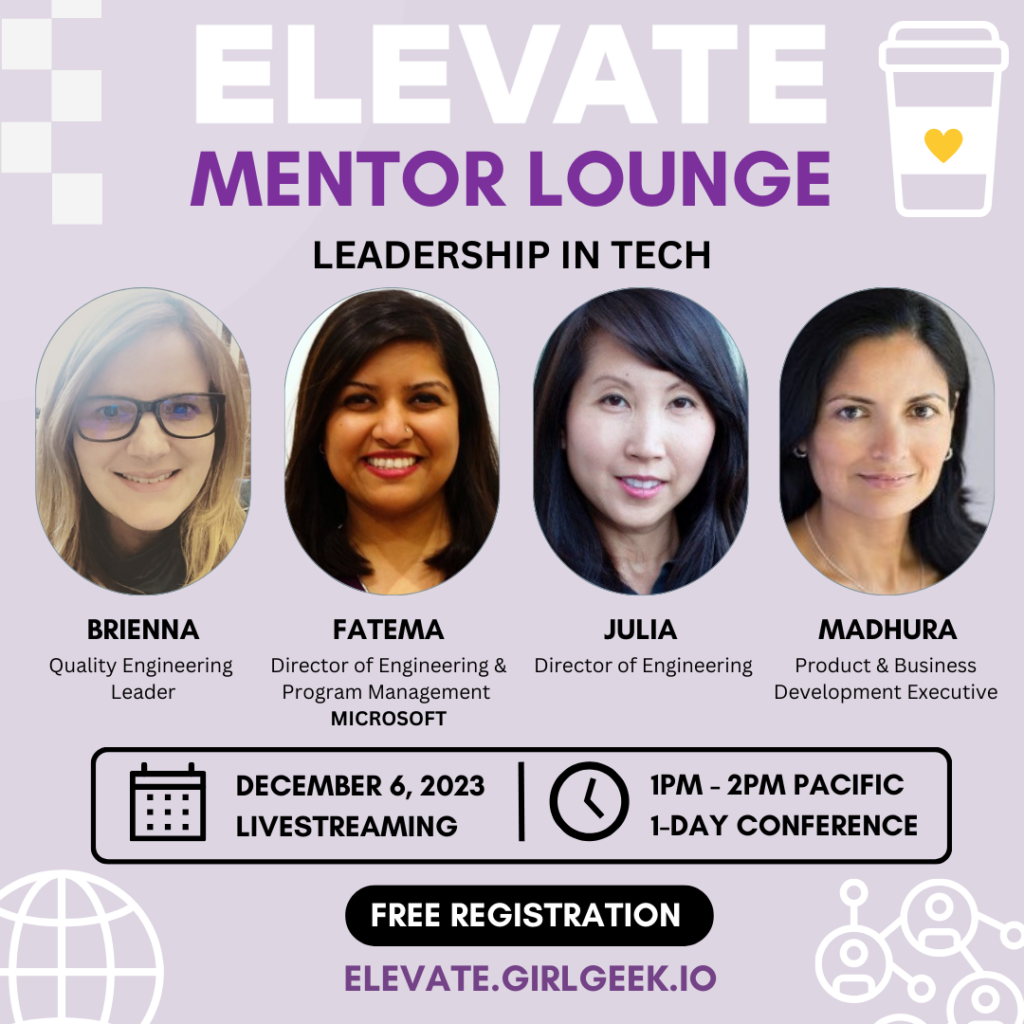
Leadership in Tech Mentors: Brienna Ransom (Quality Engineering Leader), Fatema Kothari (Director of Engineering & Program Management, Microsoft), Julia Hu (Director of Engineering), Madhura Belani (Product & Business Development Executive)


Table #6 – Leadership Mentors:

1PM – 2PM Table Topics: Revenue Operations Skills, Founding Team Member, Non-Technical, Startups, MVP Building, Web Development, Leadership for Women of Color, Agile Leadership

Elevate Mentor Table Leadership pm Ana Rottaro Maia Jones Marianne Bekker Saima Jamshed


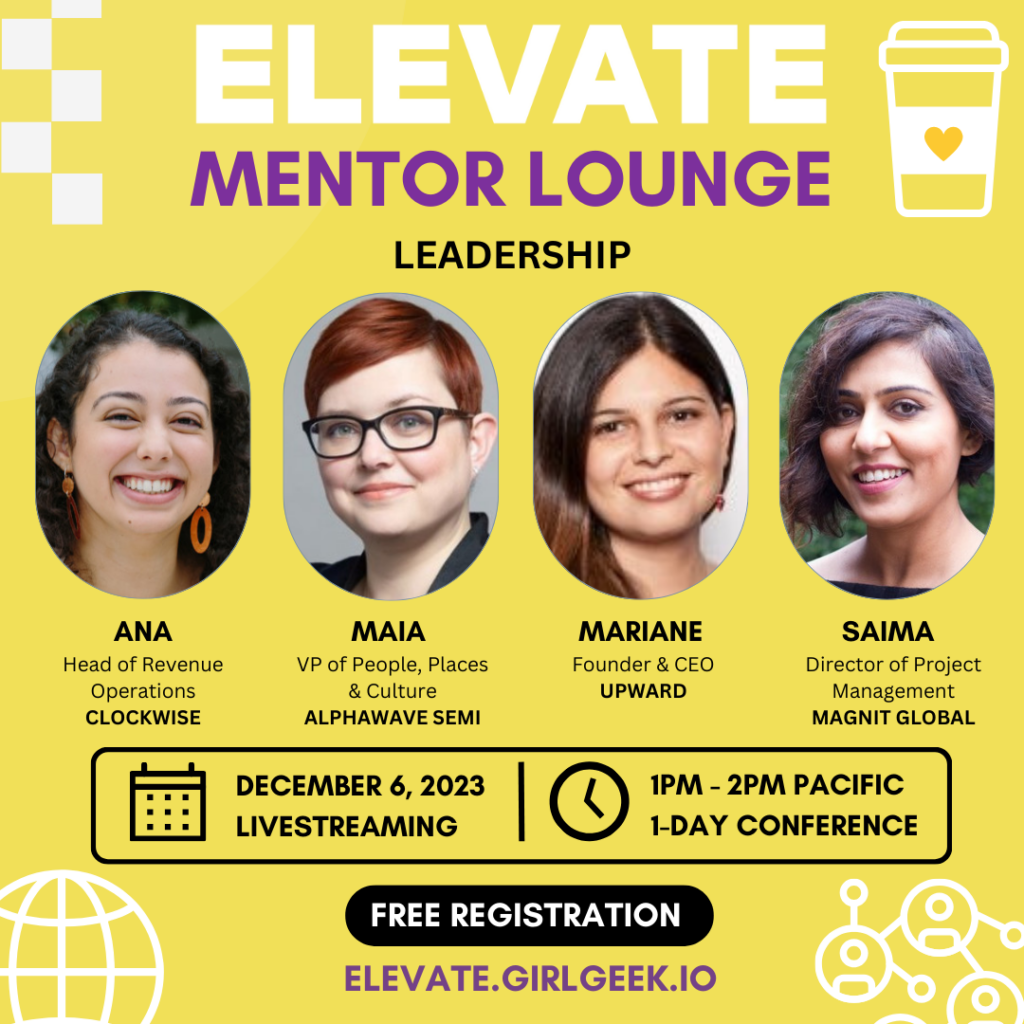
Leadership Mentors: Ana Rottaro (Head of Revenue Operations, Clockwise), Maia Jones (VP, People, Places & Culture, Alphawave Semi), Mariane Bekker (Founder & CEO, Upward), Saima Jamshed (Director, Office of Project Management, Magnit Global)


Table #7 – Non-Coding Roles in Tech Mentors:

1PM – 2PM Table Topics: Career Transitions, IT Operations Roles, Women in Technology, Imposter Syndrome, Data Visualization, Careers, Building a Portfolio, Python, Sales, Demoing, SAAS

Elevate Mentor Table Non Coding Roles in Tech pm Belisa Mandarano Liz Garcia Michelle Maraj Sarah Hudspeth


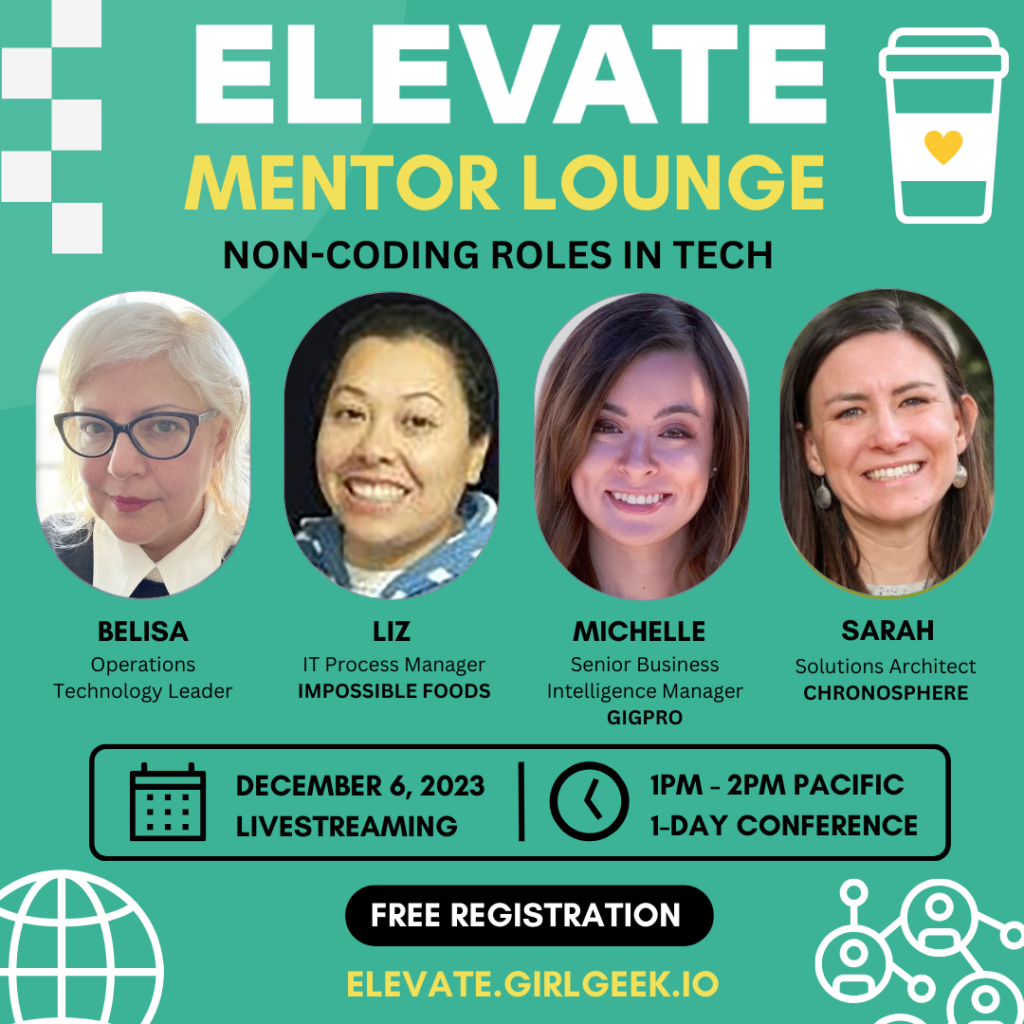
Non-Coding Roles in Tech Mentors: Belisa Mandarano (Operations Technology Leader), Liz Garcia (IT Process Manager, Impossible Foods), Michelle Maraj (Senior Business Intelligence Manager, Gigpro), Sarah Hudspeth (Solutions Architect, Chronosphere)


Table #8 – Career Transitions / Networking Mentors:

1PM – 2PM Table Topics: The Importance of Mentoring, Project Management, Career Transitions, Determining Where to Upskill, Troubleshoot Challenges, Build Confidence, Career Advice, Work / Life Balance, Industry-Level Coaching

Elevate Mentor Table Career Transitions Networking pm Carla Sexton Jo Gruszka Khushboo Malik Padmini Misra


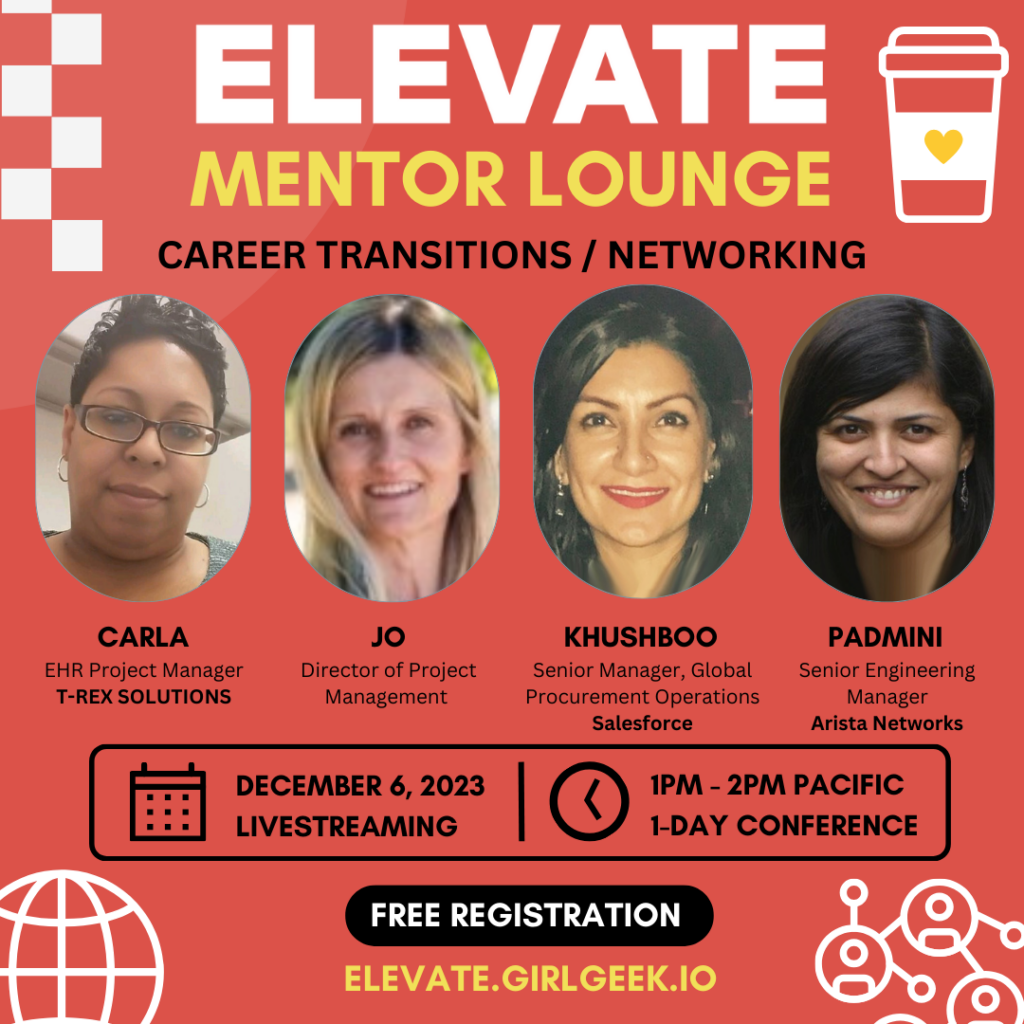
Career Transitions / Networking Mentors: Carla Sexton (Electronic Health Record Interoperability & Exposure Project Manager, T-Rex Solutions), Jo Gruszka (Director of Project Management), Khushboo Malik (Senior Manager, Global Procurement Operations, Salesforce), Padmini Misra (Senior Engineering Manager, Arista Networks)


60 Female CTOs to Watch in 2023

CTOs girl geek x headshots squares

CHECK OUT THE MOST RECENT 2025 60 FEMALE CTOs TO WATCH LIST HERE!

Did you know a woman created ChatGPT? OpenAI Chief Technology Officer (CTO) Mira Murati leads the company that creates ChatGPT.

In fact, many of the world’s biggest brands and companies are helmed by female CTOs you should know — at tech giants (Autodesk, Intuit, Microsoft, Twitch, and VMware), you can find technical women at the top of the executive chain.

You will also find technical women leading teams at your favorite consumer brands like Etsy, Expedia, Johnson & Johnson, Lululemon, Redfin, and Sweetgreen.

This year, we welcome Autodesk CTO Raji Arasu, Etsy CTO Rachana Kumar, Opendoor CTO Raji Subramanian, and Slalom CTO Michelle Grover to the top technical brass!

Here are 60 leading female Chief Technology Officers (CTOs) to watch in 2023:

1 – Autodesk Chief Technology Officer Raji Arasu

Autodesk CTO Raji Arasu

Raji Arasu is Chief Technology Officer at Autodesk in California. Autodesk (NASDAQ: ADSK) makes leading software for architecture, design, construction, engineering, and manufacturing. Prior to Autodesk, she was Senior Vice President of Platform at Intuit for 4 years, Chief Technology Officer at StubHub for 4 years, and spent over a decade at eBay, where she began as a senior manager and worked her way up to Vice President of Technology. She earned her bachelor’s in engineering at Savitribai Phule Pune University.

2 – Boundless Chief Technology Officer Emily Castles

Boundless CTO Emily Castles

Emily Castles is Chief Technology Officer at Boundless in Ireland. Boundless is an employment platform for compliance and human resources. Prior to starting Boundless, she was head of engineering at Bizimply for 3 years. She has worked as a software engineer at Red Hills Software, Grontmij, and RPS Consulting Engineers. She earned both her bachelor’s and master’s degrees at University College Dublin.

3 – Cabot Chief Technology Officer Patricia Hubbard

Patricia Hubbard is Chief Technology Officer at Cabot in Massachusetts. Cabot (NYSE: CBT) is a leading global specialty chemical and performance materials company. Before Cabot, she was Vice President of R&D at Avery Dennison, Vice President of Corporate Technology at Avient (formerly PolyOne), and CVD Technology Manager at GE, where she worked for over a decade. She earned her Ph.D. in Polymer Science at The University of Akron and her bachelor’s degree in Chemistry at Case Western Reserve University.

4 – Casper Labs Chief Technology Officer Medha Parlikar

Caspar Labs CTO Medha Parlikar

Medha Parlikar is Chief Technology Officer at Casper Labs in California. Casper is the first blockchain built specifically for business adoption. Before starting Casper, she was Program Manager at Pyrofex, a Senior Director of Product and Engineering at Avalara for 5 years, Director of Product at Temboo, Senior Manager of Quality at Omniture (acquired by Adobe), Manager of Quality Assurance (QA) at Visual Sciences, QA Engineer at DivX, Managing Director at Cactus, and Director of QA at MP3. She began her career as a Software Engineer at Compass Learning. She earned her bachelor’s degree in Biology at Western University and her bachelor’s degree in Programming at Coleman College.

5 – Change.org Chief Technology Officer Elaine Zhou

Elaine Zhou is Chief Technology Officer at Change.org in California. Change.org is the world’s largest nonprofit-owned platform for social change. Prior to Change.org, she was Chief Technology Officer at Vidado for 5 years, Chief Technology Officer at Vidado (formerly Captricity) for 4 years, Senior Vice President of Product Development at Clean Power Finance, Senior Director of Engineering at Ask, Vice President of Product Development and Technology at PlanetOut for 4 years, Director of Engineering at Classified Ventures for 2 years, Senior Consultant at Resources for 2 years, Chief Architect at Homestore for a year, Tech Lead at MedChannel.com for 2 years, Senior Application Engineer at PeopleSoft for 3 years, and a Web Developer at Stanford Linear Accelerator Center for a year. She earned her bachelor’s degree in Industrial Engineering / Operations Research at UC Berkeley.

6 – Charm Industrial Chief Technology Officer Kelly Kinetic

Kelly Hering Kinetic

Kelly Kinetic is Chief Technology Officer at Charm Industrial in California. Charm Industrial makes bio-oil from plants and puts it back underground to remove carbon from the atmosphere. Before she started Charm Industrial over 5 years ago, she was a Mechanical Design Engineer at Astra for a year, Spacecraft Engineer at Planet for 2 years, Shop Manager at Brown Design Workshop and Makerspace for 2 years. She earned her bachelor’s degree in Mechanical Engineering Systems Design at Brown University.

7 – Clutch Chief Technology Officer Simone May

Clutch CTO Simone May

Simone May is Chief Technology Officer at Clutch in Texas. Clutch gives next-generation creators access to digital work opportunities so both creators and businesses thrive. Prior to starting Clutch, she was a Consultant at Accenture for 3 years. She earned her bachelor’s degree in Computer Science at Purdue University.

8 – Curated Chief Technology Officer Annabel Liu

Curated CTO Annabel Liu

Annabel Liu is Chief Technology Officer at Curated in California. Curated provides a collaborative shopping experience brought to life with a community of passionate experts for outdoor sporting goods / gear. Before starting Curated, she was Vice President of Engineering at LinkedIn for 7 years, Senior Engineering Manager at Ariba for 9 years, Software Design Engineer at Escalate for a year, and Software Engineer at Netfish for 2 years. She earned her bachelor’s degree in Computer Science at Columbia University and her master’s degree in Computer Science at Stanford University.

9 – Ding Chief Technology Officer Barbara McCarthy

Barbara McCarthy is Chief Technology Officer at Ding in Ireland. Ding is a leading international mobile top-up platform. Prior to Ding, she was Director of Engineering at HubSpot for 3 years, Vice President of Software Development at Houghton Mifflin Harcourt for 7 years, Software Development Director at Inspired Gaming Group for 7 years, and began her career as a Project Manager. She earned her bachelor’s degree in Economics and Applied Maths and her master’s degree in Information Technology, both at University of Galway. 

10 – ESS Chief Technology Officer Julia Song

ESS CTO Julia Song

Julia Song is Chief Technology Officer at ESS in Oregon. ESS (NYSE: GWH) accelerates global decarbonization by providing safe, sustainable, long-duration energy storage to power people, communities, and businesses with clean, renewable energy. Before starting ESS over a decade ago, she was Vice President of Research and Development at ClearEdge Power for 7 years, Industrial Research Chemist at Milliken & Co for a year, and Research Assistant at University of North Carolina at Chapel Hill for 5 years. She earned her Ph.D. in Analytical Chemistry at University of North Carolina at Chapel Hill and her bachelor’s degree in Chemistry at Peking University.

11 – Etsy Chief Technology Officer Rachana Kumar

Etsy CTO Rachana Kumar

Rachana Kumar is Chief Technology Officer at Etsy in New York. Etsy (NYSE: ETSY) is a global marketplace for unique and creative goods. She was promoted from Vice President of Engineering in 2021, and has been at Etsy for 8 years, when she joined as an Engineering Manager. Prior to Etsy, she co-founded ShaadiKarma for 2 years, was a Graduate Consultant at Columbia University for 2 years, interned at United Nations Population Fund, worked as Lead Software Architect at Brighter India Foundation for 2 years, managed Web Development at BET Networks for 3 years, consulted at Ernst & Young for a year, and began her career as a Programmer Analyst at Cognizant for a year. She earned her bachelor’s degree in Electronics and Communication at RV College of Engineering and a master’s degree in Public Administration at Columbia University.

12 – Expedia Chief Technology Officer Rathi Murthy

Rathi Murthy is Chief Technology Officer at Expedia in California. Expedia (NASDAQ: EXPE) is a leading platform for travel. Prior to Expedia, she was Chief Technology Officer at Verizon Media for a year, Chief Technology Officer at Gap for 3 years, Senior Vice President at American Express for 3 years, Senior Director of Engineering at eBay for 2 years, Senior Director of Engineering at Yahoo for 5 years, Director of Engineering at Metreo for 5 years, Senior Engineering Manager at WebMD for 4 years, Senior Software Engineer at Sun Microsystems for 3 years, QA Manager at Sun for 1 year, and began her career as a QA Lead at Informix. She earned her bachelor’s degree in Electrical Engineering at Bangalore University and her master’s degree in Computer Engineering at Santa Clara University.

13 – ezCater Chief Technology Officer Erin DeCesare

Erin DeCesare is Chief Technology Officer at ezCater in Massachusetts. ezCater is the leading marketplace for corporate catering. Before ezCater, she was Vice President of Data and Analytics at Bottomline Technologies for a year, Vice President of Data and Analytics at Vistaprint for 8 years, Director of Program Management at Fidelity Investments for 3 years, Project Manager at Sovereign Bank for 5 years, Project Manager at Woodman Design Group for a year, and began her career as an Information Technology Account Manager at Signature for a year. She earned her bachelor’s degree in Biology at Boston University and her MBA at Northeastern University.

14 – FeelIT Chief Technology Officer Meital Segev-Bar

FeelIT CTO Meital Segev Bar

Meital Segev-Bar is Chief Technology Officer at FeelIT in Israel. Feelit Technologies provides sensing solutions for real-time insights for manufacturers. Before starting FeelIT over 6 years ago, she was a Development Engineer at Alfred Mann Institute in the Technion for a year, and held a Research and Development position at Tower Semiconductor for a year. She earned her Ph.D. in Nanotechnology and her bachelor’s degree in Chemistry and Material Engineering, both at Technion – Israel Institute of Technology.

15 – GE Renewable Energy Chief Technology Officer Danielle Merfeld

Danielle Merfeld is Chief Technology Officer at GE Renewable Energy in North Carolina. GE (NYSE: GE) Renewable Energy provides solutions for customers demanding reliable and affordable green power. Prior to GE Renewable Energy, she was Vice President and General Manager of GE Global Research US for 5 years, Solar Business Leader at GE Energy for a year, Solar Platform Leader at GE Global Research for over a decade, and began her career as a Wide Bandgap Semiconductor Researcher at GE. She earned her Ph.D. in Electrical and Electronics Engineering at Northwestern University and her bachelor’s degree in Electrical and Electronics Engineering at University of Notre Dame.

16 – Getlabs Chief Technology Officer Claire Hough

Claire Hough is Chief Technology Officer at Getlabs in California. Prior to Getlabs, she was Chief Technology Officer at Carbon Health, a tech-enabled healthcare company providing primary and urgent care. Prior to Carbon Health, she was Chief Technology Officer at Lyte, Vice President of Engineering at ApolloQL, Senior Vice President of Engineering at Udemy, Senior Vice President of Engineering at Nextag, Senior Vice President of Engineering at Napster, and Vice President at Netscape. She earned her bachelor’s degree in Engineering and master’s degree in Operations Research, both at UC Berkeley.

17 – Ghost Foundation Chief Technology Officer Hannah Wolfe

Hannah Wolfe is Chief Technology Officer at Ghost Foundation in England. Ghost is an open source publishing platform for new-media creators to share and grow a business around their content. Before co-founding Ghost Foundation 9 years ago, she worked as a Senior Developer at Moo.com for 2 years and began her career as an Interactive Developer at Engine Creative for 2 years. She earned her bachelor’s degree in Computer Science at University of Nottingham, and her MBA at Nottingham University Business School.

18 – Halma Chief Technology Officer Catherine Michel

Halma CTO Catherine Michel

Catherine Michel is Chief Technology Officer at Halma in England. Halma (LON:HLMA) is a global group of life-saving technology companies, from safety to environmental and medical. Before joining Halma over 3 years ago, she was Chief Technology Officer at Sigma Systems for 6 years, Executive Committee Member at TM Forum for 11 years, Trustee at Skylarks Charity for 6 years, Founder and Chief Technology Officer at Tribold for a decade. She began her career at Accenture as a Senior Manager for 9 years. She earned her bachelor’s in Finance at University of Michigan – Stephen M. Ross School of Business.

19 – Honeycomb Chief Technology Officer Charity Majors

Charity Majors is Chief Technology Officer at Honeycomb.io in California. Honeycomb provides full-stack observability designed for high cardinality data and collaborative problem solving for engineers to understand and debug production software. Prior to co-founding Honeycomb over 7 years ago, she was a Production Engineering Manager at Facebook for 2 years, Infrastructure Tech Lead at Parse for a year, Cloud Systems Engineer at Cloudmark for a year, Systems Engineer at Shopkick for a year, and began her career as a Systems Engineer and Systems Engineering Manager at Linden Lab for 5 years. She attended University of Idaho. She has published books on database reliability engineering and observability engineering.

20 – Intuit Chief Technology Officer Marianna Tessel

Marianna Tessel is Chief Technology Officer at Intuit in California. Intuit (NASDAQ: INTU) is a global financial technology platform with TurboTax, QuickBooks, Credit Karma and Mailchimp. Before joining Intuit 4 years ago, she was Senior Vice President of Engineering at Docker for 2 years, Vice President of Engineering at VMware for 6 years, Vice President of Engineering at Intacct for a year, Vice President of Engineering at Ariba for 6 years, Vice President of Engineering at General Magic for 6 years, and began her career as Captain at IDF for 4 years. She earned her bachelor’s degree in Computer Science at Technion – Israel Institute of Technology.

21 – Johnson & Johnson Chief Technology Officer Rowena Yeo

Rowena Yeo is Chief Technology Officer at Johnson & Johnson in Singapore. Johnson & Johnson (NYSE: JNJ) is the largest and most broadly based healthcare company in the world. Before joining Johnson & Johnson 4 years ago, she was Vice President and Chief Information Officer for Asia Pacific at Janssen Pharmaceutical for 6 years, and Global Group Chief Information Officer at Cargill for 11 years, and her early career began as a Systems Engineer at IBM for 3 years. She earned her bachelor’s degree in Engineering at National University of Singapore.

22 – Kantar Chief Technology Officer Alex Cesar

Alex Cesar is Chief Technology Officer at Kantar in England. Kantar is the world’s leading marketing data and analytics company. Prior to Kantar, she was Chief Information Officer at London Stock Exchange Group, Chief Technology Officer at Refinitive for 4 years, Chief Technology Officer at World in Banking and Finance – UK for a year, Global Head of Risk Technology at Thomson Reuters for 2 years, Governance and Legal Technology Head at Deutsche Bank for 2 years, Head of Compliance Technology Strategy at JP Morgan for a year, Head of Compliance and Assurance Technology at Standard Chartered Bank for 4 years, Head of Enterprise Shared Services Technology at Barclays Capital for 2 years, Senior Engineering Manager at First Data Utilities for 2 years, Project Manager at Morgan Stanley for 5 years, and she began her early career as a Technical Analyst at HSBC for 2 years. She earned her bachelor’s degree in Electrical Engineering at Faculdade de Engenharia de Sao Paulo and her MBA at Cass Business School.

23 – Krikey Chief Technology Officer Ketaki Shriram

Krikey CTO Ketaki Shriram

Ketaki Shriram is Chief Technology Officer at Krikey in California. Krikey is an artificial intelligence (AI) tools company whose products include text to-animation, custom 3D avatar tool, augmented reality gaming toolkit and more. Before co-founding Krikey with her sister 6 years ago, she was a PhD Researcher at Stanford’s Virtual Human Interaction Lab for 5 years, a PhD Researcher at Oculus, and User Experience Researcher at Google Glass. She earned her bachelor’s degree in Communication, master’s degree in Virtual Human Interaction, and Ph.D. in Virtual Human Interaction Lab, all at Stanford University.

24 – Kapor Center Chief Technology Community Officer Lili Gangas

Lili Gangas is Chief Technology Community Officer at Kapor Center in California. The Kapor Center is leveling the playing field and building a future where the tech industry makes a positive impact on culture, society and the economy. Prior to joining Kapor Center 7 years ago, she was Lead Associate at Booz Allen Hamilton for 2 years, NYU Entrepreneurial Institute Programs MBA Intern for a year, and a Senior Multi-Disciplined Engineer at Raytheon for 7 years. She earned her bachelor’s degree in Electrical Engineering at USC and her MBA at NYU Stern School of Business.

25 – Kennametal Chief Technology Officer Carlonda Reilly

Carlonda Reilly is Chief Technology Officer at Kennametal in Pennsylvania. Kennametal (NYSE: KMT) is a global industrial technology leader delivering productivity to customers through materials science, tooling and wear-resistant solutions. Before joining Kennametal 4 years ago, she was at DuPont for over two decades, most recently as Global Technology Director of Nylon, Polyester and Filaments. In her early carer, she joined DuPont as a Senior Research Engineer for Crop Protection and Central Research and Development. She earned her bachelor’s degree in Chemical Engineering at MIT, and an MS, Chemical Engineering and PhD, Chemical Engineering at University of Delaware.

26 – Leaf Chief Technology Officer Helga Alvarez

LEAF CTO Helga Alvarez

Helga Alvarez is Chief Technology Officer at Leaf in England. Leaf combines years of full-funnel marketing expertise with proprietary growth-engine technology to deliver revenue and sustainable growth for clients. Prior to joining Leaf over a decade ago, she was Co-Founder and Creative Technologist at Cometoide for a year, Software Developer at Possible Worldwide for a year, Visiting Research Scientist at Korea Institute of Science and Technology for a year, and Product Management and Marketing at FMWebschool for a year. She earned her bachelor’s in Software Engineering at Universidad Latina de Costa Rica.

27 – LimeLoop Chief Technology Officer Chantal Emmanuel

Chantal Emmanuel is Chief Technology Officer at LimeLoop in New York. LimeLoop’s smart shipping platform combines reusable packaging and a simple sensor for a real-time lens into the e-commerce experience. Retailers have a powerful platform to effectively understand and communicate with their customers, while providing the insights necessary to inform ESG and supply chain decisions. Before co-founding LimeLoop 5 years ago, she was a Software Engineer at SYPartners for a year, Lead Software Engineer at Red Clay for 3 years, Community Program Officer at New York Cares for 3 years, and began her early career in AmeriCorps VISTA. She earned her bachelor’s degree at Binghamton University and studied entrepreneurship at Cornell University.

28 – Lululemon Chief Technology Officer Julie Averill

Julie Averill is Chief Technology Officer at Lululemon in Washington. Lululemon (NASDAQ:LULU) is an athletic apparel company for yoga, running, training, and most other sweaty pursuits, creating transformational products and experiences which enable people to live a life they love. Prior to joining Lululemon 6 years ago, she was Chief Information Officer at REI for 2 years, Vice President of Selling and Marketing Systems at Nordstrom for 11 years, and an Adjunct Professor at Seattle University for 3 years. She earned her bachelor’s degree in Computer Science at Seattle Pacific University and her MBA at University of Washington – Michael G. Foster School of Business.

29 – Lyra Health Chief Technology Officer Jenny Gonsalves

Jenny Gonsalves is Chief Technology Officer at Lyra Health in California. Lyra Health is a leading provider of mental health benefits for over 2.5 million global employees and dependents and is transforming mental health care by creating a frictionless experience for members, providers, and employers. Before joining Lyra Health over 6 years ago, she was Vice President of Engineering at SugarCRM for a decade, Senior Software Engineer at Epiphany for 6 years, and began her early career as Programmer Analyst at RBC Dominion Securities for a year. She earned her bachelor’s degree in Computer Science at University of Toronto.

30 – Manara Chief Technology Officer Laila Abudahi

Laila Abudahi is Chief Technology Officer and co-founder at Manara in California. Meaning “lighthouse” in Arabic, Manara is on a mission to untap the full human potential in MENA and diversify the global tech sector.  Before Manara, she was a Senior Software Engineer at Nvidia for 2 years. a Dataplane Software Engineer at Palo Alto Networks for 2 years, and founded MOTION in Gaza to develop Kinect-based interactive educational solutions for kids. She earned her bachelor’s degree in Computer Engineering at Al-Azhar University in Gaza, and her master’s degree in Electrical, Electronics, and Communications Engineering at University of Washington, where she was a Fulbright Scholar.

31 – McKesson Chief Technology Officer Nancy Avila

Nancy Avila is Chief Technology Officer at McKesson in Texas. McKesson (NYSE: MCK) is a global healthcare organization dedicated to advancing health outcomes for all. Prior to joining McKesson 3 years ago, she was Vice President and Chief Information Officer at Johnson Controls for 2 years, and worked at Abbot for over two decades, most recently as Vice President of Business and Technology Services. She began her career at Abbott as an IT Manager in Quality and Research and Development. She earned her bachelor’s degree in Mathematics and Computer Science at Regis University and her master’s degree in Mathematics at Colorado School of Mines.

32 – Microsoft Global Partner Solutions Chief Technology Officer Lakecia Gunter

Lakecia Gunter Microsoft

Lakecia Gunter is Chief Technology Officer at Microsoft Global Partner Solutions in Oregon. Microsoft (NASDAQ: MSFT) is the largest computer software company in the world. Prior to Microsoft, she was at Intel Corporate for over a decade, most recently as Vice President of Programmable Solutions. She serves on the board of directors for IDEX Corporation. She earned her bachelor’s in computer engineering at University of South Florida, and her master’s in electrical engineering at Georgia Institute of Technology.

33 – Microsoft Security Chief Technology Officer Michal Braverman-Blumenstyk

Microsoft Security CTO Michal Braverman Blumenstyk

Michal Braverman-Blumenstyk is Chief Technology Officer at Microsoft Security in Israel. Microsoft (NASDAQ: MSFT) Security provides comprehensive security solutions. Prior to joining Microsoft a decade ago, she worked as General Manager at RSA (the security division of EMC) for 7 years, Chief Operating Officer at Cyota (acquired by RSA) for 3 years, and Vice President of Product Development at RadView for 7 years. She earned her master’s in Computer Science at Columbia University.

34 – Momentive Chief Technology Officer Robin Ducot

Momentive CTO Robin Ducot

Robin Ducot is Chief Technology Officer at Momentive in California. Momentive (NASDAQ: MNTV) provides enterprise solutions for agile experience management and insights from Momentive, GetFeedback, and SurveyMonkey. Before joining Momentive 5 years ago, she was Senior Vice President of Product Engineering at DocuSign for 6 years, Vice President of Engineering at Eventbrite for a year, Vice President of Web Development at Linden Lab, Vice President of Web, User Experience and Engineering Group at Adobe Systems for 7 years, Vice President of Professional Services at Avolent for 4 years, Senior Manager of Internet Development for a year, Lead Software Engineer at AT&T for 2 years, and began her early career as Senior Software Engineer at BGS Systems for 6 years. She earned her bachelor’s degree in Computer Science and Art History at UMass Boston.

35 – Navenio Chief Technology Officer Niki Trigoni

Niki Trigoni is Chief Technology Officer at Navenio in England. Navenio develops infrastructure-free, highly scalable, accurate and robust indoor location solutions built on award-winning and world-leading research from the University of Oxford, utilizing existing smartphone devices to localize people within a broad range of contexts and markets.  Prior to starting Navenio, she was Professor of Computer Science and Head of Cyber Physical Systems Group at University of Oxford for 15 years, Lecturer in Computer Science at University of London Birkbeck, and Postdoc Researcher at Cornell University. She earned her Ph.D. in Computer Science at University of Cambridge and her bachelor’s degree in Computer Science at Athens University of Economics and Business.

36 – NovoEd Chief Technology Officer Farnaz Ronaghi

Farnaz Ronaghi is Chief Technology Officer at NovoEd in California. NovoEd provides a collaborative learning platform to empower organizations to design and deliver experiential learning. Before co-founding NovoEd over a decade ago, she was working on a PhD at Stanford University with a dissertation on collaborative learning at scale. The company spun out of Stanford University’s social algorithm laboratory in 2012. She earned her bachelor’s degree in Computer Engineering at Sharif University of Technology and her master’s in Management Science and Engineering at Stanford University.

37 – Nylas Chief Technology Officer Christine Spang

Christine Spang is Chief Technology Officer at Nylas in California. Nylas allows developers to access communications channels such as email, calendar, and contacts using rich application programming interfaces (APIs). Prior to co-founding Nylas almost a decade ago, she was working as a Principal Developer at Oracle for 2 years, Software Engineer at KSplice for 2 years, Perl Hacker at Best Practical Solutions for 2 years, and Residential Computing Consultant / Lab Assistant at MIT for 2 years. She earned her bachelor’s degree in Computer Science at MIT.

38 – OpenAI Chief Technology Officer Mira Murati

OpenAI CTO Mira Murati

Mira Murati is Chief Technology Officer at OpenAI in California. Developer of ChatGPT, OpenAI is an AI research and deployment company dedicated to ensuring that general-purpose AI benefits all of humanity. Before joining OpenAI 4 years ago, she was Vice President of Product and Engineering at Leap Motion for 2 years, Senior Product Manager for Model X at Tesla for 3 years, Advanced Concepts Engineer at Zodiac Aerospace for a year, and began her early career as a Summer Analyst at Goldman Sachs. She earned her bachelor’s degree in Mechanical Engineering at Dartmouth College.

39 – Opendoor Chief Technology Officer Raji Subramanian

Opendoor CTO Rajalakshmi Subramanian

Raji Subramanian is Chief Technology Officer at Opendoor in Washington. Opendoor (NASDAQ: OPEN)  is an online company that buys and sells residential real estate. Prior to joining Opendoor 2 years ago, she was Chief Technology Officer at Pro.com for 8 years, Head of Kindle Content Management at Amazon for a year, Co-Founder and Chief Executive Officer at Radien Software for 3 years, Finance Engineering Leader at Yahoo for a year, held multiple leadership roles including Principal Engineer at Amazon for 6 years, Manager of Software Development and Lead Engineer at Microland for 2 years, and began her early career as a Research Engineer at Indian Institute of Science.

40 – Outer Labs Chief Technology Officer Jen Carlile

Jen Carlile is Chief Technology Officer at Outer Labs in California. Outer Labs makes technology for real estate developers to design, build, and operate space. Prior to co-founding Outer Labs 5 years ago, she was Vice President of Engineering and Co-Founder at Flux Data for 5 years, Software Engineer at Google[X] for 2 years, Senior Software Engineer at Avid Technology for a year, Software Engineer at Sennheiser GmbH for a year, Software Engineer at Euphonix for 2 years, and began her early career as an Audio and Acoustics Engineer at AuSIM. She earned her bachelor’s degree in Media Arts and Computer Science at Wellesley College and her master’s degree in Digital Audio / Music at Stanford University.

41 – Pilot Chief Technology Officer Jessica McKellar

Jessica McKellar is Chief Technology Officer at Pilot in California. Pilot provides the most reliable accounting, CFO, and tax services for startups and small businesses. Before co-founding Pilot 6 years ago, she was Director of Engineering at Dropox for 3 years, Vice President of Engineering and Founder at Zulip for 2 years, Engineering Manager at Oracle for a year, and Software Engineer at Ksplice (acquired by Oracle) for a year. She earned her bachelor’s degree in Computer Science and master’s degree in Computer Science, both at MIT.

42 – Pleo Chief Technology Officer Meri Williams

Meri Williams is Chief Technology Officer at Pleo in England. Pleo offers smart company cards that enable employees to buy the things they need for work, all while keeping a company’s finance team in control of spending. Prior to joining Pleo, they were Chief Technology Officer at Healx for 2 years, Chief Technology Officer at Monzo Bank for 2 years, Chief Technology Officer at Moo.com for 2 years, Chief Technology Officer at M&S.com for a year, Chief Technology Officer and Founder at Balloon Studios for 2 years, Head of Operations for North Europe Site Services at Procter & Gamble for a decade. They earned their bachelor’s degree in Computer Science at University of Bath.

43 – Praxis Labs Chief Technology Officer Theresa Vu

Praxis Labs CTO Theresa Vu

Theresa Vu is Chief Technology Officer at Praxis Labs in New York. Praxis Labs is making society more equitable by advancing workplace inclusion and belonging. Before joining Praxis Labs, she was Senior Vice President of Engineering at Xandr, where she worked for 12 years – starting as a Senior C Developer. She began her early career as an Analyst at Yahoo! and Right Media. She earned her bachelor’s degree at UC Berkeley and her master’s degree in Computer Science at Brown University.

44 – Precisely Chief Technology Officer Tendü Yoğurtçu

Tendü Yoğurtçu is Chief Technology Officer at Precisely in Massachusetts. Precisely is the global leader in data integrity, providing accuracy, consistency, and context in data for 12,000 customers in more than 100 countries, including 99 of the Fortune 100. Prior to joining Precisely 4 years ago, she worked at Syncsort for 12 years, most recently as Chief Technology Officer. She began her early career as an Adjunct Professor at Stevens Institute of Technology in the Computer Science Department. She earned her PhD in Computer Science at Stevens Institute of Technology, her master’s degree in Industrial Engineering, and her bachelor’s degree in Computer Engineering, both at Boğaziçi University in Turkey.

45 – Redfin Chief Technology Officer Bridget Frey

Bridget Frey is Chief Technology Officer at Redfin in Washington. Redfin (NASDAQ: RDFN) is the modern way to buy or sell a home. Redfin serves 100+ major metros in the U.S. and has saved customers more than $1B in commissions. Before joining Redfin 12 years ago, she was Director of Engineering at Lithium Technologies for 3 years, Vice President of Development at IntrisiQ for 2 years, Senior Program Manager at IMlogic for a year, and began her early career as Software Engineering Manager at Plumtree for 4 years. She earned her bachelor’s in Computer Science at Harvard University.

46 – QA Chief Technology Officer Katie Nykanen

Katie Nykanen is Chief Technology Officer at QA in England. QA is the UK’s leading tech training and talent services provider, helping businesses and individuals win in the digital revolution by upskilling FTSE100 and government clients. Prior to QA, she was Chief Technology Officer at Adstream for almost a decade, Marketing Solutions Development Manager at Nokia for 6 years, IT Project Leader at B&Q for a decade.

47 – ResMed Chief Technology Officer Urvashi Tyagi

Urvashi Tyagi is Chief Technology Officer at ResMed in California. ResMed (NYSE: RMD, ASX: RMD) provides cloud-connected medical devices for patients. Before joining ResMed, she was Chief Technology Officer at ADP for 2 years, Vice President of Commercial Data Engineering at American Express for 2 years, Director of Engineering at Amazon for 3 years, Engineering Manager at iCIMS for a year, Senior Engineering Manager at Microsoft for 5 years, Team Lead and Architect at IBM for 5 years, and began her early career as a Software Engineer at NuGenesis Technologies (acquired by Waters) for 2 years and Senior Design Engineer at Batliboi for 5 years. She earned her bachelor’s degree in engineering at Birla Vishvakarma Mahavidyalaya, MBA at Veer Narmad South Gujarat University, and her master’s degree in Science at Worcester Polytechnic Institute.

48 – SCiFi Foods Chief Technology Officer Kasia Gora

SCiFiFoods CTO Kasia Gora

Kasia Gora is Chief Technology Officer at SCiFI Foods in California. SCiFi Foods is on a mission to make meat the world can depend on, using bioengineering to create the next generation of meat products. Prior to co-founding SCiFI Foods, she was Head of Portfolio Management at Zymergen for 6 years, and began her early career as Scientist at Pronutria for 2 years. She earned her Ph.D. in Biology at MIT and her bachelor’s degree in Biology at Caltech.

49 – Slalom Chief Technology Officer Michelle Grover

Slalom CTO Michelle Grover

Michelle Grover is Chief Technology Officer at Slalom in California. Slalom is a global business and technology consulting company that is purpose-led. Before joining Slalom, she was Chief Information Officer at Twilio for a year, Consulting CTO at Softcom for a year, and Vice President of Research and Development at Tripit for 7 years.

50 – Sterling Chief Technology Officer Ivneet Kaur

Ivneet Kaur is Chief Technology Officer at Sterling in Florida. Sterling (NASDAQ: STER) is a leading provider of background and identity services with background and identity verification to help over 50,000 clients create people-first cultures built on a foundation of trust and safety. Prior to joining Sterling, she was Chief Technology Officer at Silicon Valley Bank for 3 years, Chief Technology Officer and Chief Information Officer at Equifax for 4 years, Technology Leader at Equifax for 6 years, Product Development Manager at Claritas for 6 years, and she began her early career as Software Engineer at Microsoft for 2 years. She earned her master’s degree in Engineering Management at University of Maryland.

51 – Sweetgreen Chief Technology Officer Wouleta Ayele

Sweetgreen CTO Wouleta Ayele

Wouleta Ayele is Chief Technology Officer at Sweetgreen. Sweetgreen (NYSE: SG) believes that real food should be convenient and accessible to everyone, making salads from scratch at scale. Before joining Sweetgreen, she was Senior Vice President of Technology at Starbucks for 15 years, Senior Director of Information Systems and Business Intelligence at Attachmate for 11 years, IT Leader of Corporate Technology at The Coca-Cola Company for 4 years, Engineering Manager at Hyundai Motor America for 4 years, and she began her early career as Enterprise Architect and Engineer at CIBA Vision. She earned her bachelor’s degree in Computer Science at Cumberland University and her master’s degree in International Finance at Mercer University.

52 – SwipeGuide Chief Technology Officer Sue Li

SwipeGuide CTO Sue Li

Sue Li is Chief Technology Officer at SwipeGuide in Amsterdam. SwipeGuide empowers frontline teams to boost operational performance with crowdsourced knowledge. Improve productivity, safety, and quality across operations with collaborative work instructions. Prior to joining SwipeGuide 3 years ago, she was Product Owner at Albelli for 2 years, Interaction Designer at Poki for a year, and Chief Product Officer at Bomberbot for a year. She earned a bachelor’s degree at Duke University and a master’s degree in Education at Harvard Graduate School of Education.

53 – Textio Chief Technology Officer Tacita Morway

Textio CTO Tacita Morway

Tacita Morway is Chief Technology Officer at Textio in Massachusetts. Textio has developed the world’s most advanced workplace language guidance, so you can see where social bias is hiding—and know exactly how to fix it. Our solutions help organizations attract, develop, and retain diverse, inclusive, and equitable teams—at scale. Before joining Textio, she was Executive Vice President of Engineering and Product at ActBlue for 3 years, Director of Engineering at Salsify for 2 years, Vice President of Engineering and Product at Ditto Labs for 2 years, Director of Technology at WGBH for 2 years, Founder at Tacita Gardens for 3 years, Founder at Tacita Designs for 6 years, Software Engineer at Context Integration for a year, IT Consultant at Wellesley College Information Services for a year, and began her early career as an Apprentice Mechanic at Chicago Auto for 2 years. She earned a bachelor’s degree in Computer Science at Wellesley College, and a bachelor’s degree in Painting and Drawing at School of the Art Institute of Chicago.

54 – Thrasio Chief Technology Officer Pawan Uppuluri

Pawan Uppuluri is Chief Technology Officer at Thrasio in Massachusetts. Thrasio is a next-gen consumer packaged goods company using a data-driven approach to analyze Amazon rankings, ratings, and reviews to identify and acquire breakout brands. Prior to joining Thrasio, she was Chief Technology Officer at Glossier for 2 years, and Director of Product and Technology for Alexa at Amazon for 14 years. She began her early career at i2 Technologies for 8 years, most recently as Engineering & Product Director. She earned her bachelor’s degree in Chemical Engineering at Indian Institute of Technology, Madras, and her master’s degree in Computer Engineering at The University of Texas at Austin.

55 – ThoughtWorks Chief Technology Officer Rebecca Parsons

Rebecca Parsons is Chief Technology Officer at ThoughtWorks in Washington. Thoughtworks (NASDAQ: TWKS) is a global technology consultancy that integrates strategy, design and engineering to drive digital innovation. She has been at ThoughtWorks for over two decades. She earned her Ph.D. in Computer Science at Rice University.

56 – Token Transit Chief Technology Officer Ekaterina Kuznetsova

Ekaterina Kuznetsova is Chief Technology Officer at TokenTransit in California. Token Transit is a shared mobility marketplace for over 60 cities across the United States, including Santa Monica CA, Tallahassee FL, Lincoln NE, Reno NV and more. Before co-founding TokenTransit, she was Core Developer at Meteor Development Group for 2 years, Software Engineer at Google for 1 year, and began her early career as Software Engineer at Akamai Technologies for 3 years. She earned her bachelor’s in Computer Science at MIT.

57 – Transposit Chief Technology Officer Tina Huang

Tina Huang is Chief Technology Officer at Transposit in California. Transposit keeps track of everything that happens during daily operations and incidents, while streamlining communication, augmenting your team with interactive runbooks, and accelerating actions between systems with the context you need. Prior to founding Transposit, she was Founding Engineer at Sigma Computing for a year, Staff Software Engineer at Twitter for 5 years, Senior Software Engineer at Google for 4 years, and began her early career as Software Engineer at Apple for 3 years. She earned her bachelor’s degree in Electrical Engineering and Computer Science at MIT.

58 – Twelve Chief Technology Officer Kendra Kuhl

Kendra Kuhl is Chief Technology Officer at Twelve in California. Twelve is a chemical company built for the climate era providing technology that eliminates emissions by turning CO2 into essential products by way of carbon transformation. Before co-founding Twelve (formerly named Opus 12), she was Cyclotron Road Project Lead for a year, Postdoc at SLAC National Accelerator Laboratory for a year, and Graduate Researcher at Stanford University’s Jaramillo Lab for 5 years. She earned her Ph.D. in Chemistry at Stanford University and her bachelor’s degree in Chemistry at University of Montana.

59 – Twitch Chief Technology Officer Christine Weber

Twitch CTO Christine Weber

Christine Weber is Chief Technology Officer at Twitch in Colorado. Acquired by Amazon, Twitch is where thousands of communities come together for whatever, every day. Prior to joining Twitch, she was Interim Chief Technology Officer at Liberty Latin America, Senior Vice President of OTT Engineering at Sling TV for 3 years, and was at EchoStar for 18 years, most recently as Vice President of OTT Engineering. She also spent 7 years at Coastal, most recently as Manager of Worldwide DBA Services. She began her early career as a Software Engineer at In-Situ for 5 years. She earned her degree in Computer Science and Electrical Engineering at University of Wyoming.

60 – VMware Americas Chief Technology Officer Amanda Blevins

VMware CTO Amanda Blevins

Amanda Blevins is Chief Technology Officer at VMware Americas in Colorado. VMware is a leading provider of multi-cloud services for enterprise. Before joining VMware over 12 years ago, she was Principal Architect at IHS for 2 years, Senior Consultant for Electronic Data Systems for a year, Technical Lead for ITD Server Solutions at Johns Manville for 3 years, Network Engineer at DCS for a year, Senior Network Administrator at FrontRange Solutions for 2 years, and she began her early career as Network Administrator, Lab Administrator, and Helpdesk Technician. She earned her bachelor’s degree in Computer Science at American Sentinel University.

We love seeing where women’s careers take them over the years! Technical women leaders of large and small organizations have demonstrated different pathways to moving up. Sometimes they move up over a decade. Sometimes they are recruited and hired to the top. Some of our favorite technical women are entrepreneurial and spend time outside of the corporate race to the top and instead build their own company, or join an early-stage startup. And there are many more women coming up in the corporate and startup ranks.

girl geek x elevate x march creative marketing

Get your FREE Elevate conference pass to join us and celebrate International Women’s Day on March 7-8, 2024 with thousands of women & allies online!

Hear from 55+ women speakers sharing their expertise on engineering, leadership, career planning, interviewing, AI, much more! 

Check out the agenda + grab your FREE ticket to join the livestream event!

For more inspiring women in tech:

Navigating College And Career As First-Gen Girl Geeks: Insights From CCPA Career Panel of Women in Tech

girl geek x ccpa career panel vanessa Vanessa magana an nguyen molly dubow bryanna valdivia elizabeth orpina hero

Girl Geek X continues its ongoing partnership with Oakland Public Education Fund to support Coliseum College Prep Academy. Girl Geek X volunteers actively engage with the local school community to illuminate the journeys of women in technology who have overcome diverse challenges to achieve successful careers in fields ranging from art and design to engineering and cybersecurity.

On Wednesday, October 4, 2023, Girl Geek X community members volunteered to share career advice with the senior class at CCPA in East Oakland, California.

An Nguyen (Lead Product Designer at Medallia), Molly Dubow (Customer Success Leader most recently at Webex), Bryanna Valdivia (Software Engineer at Flexport), and Elizabeth Orpina (Security Awareness & Education Manager at GitHub) spoke on a career panel to share their path from high school to successful careers in the tech sector. They offered valuable advice to students.

Below are key takeaways from the college and career panel discussion:

girl geek x ccpa career panel vanessa Vanessa magana an nguyen molly dubow bryanna valdivia elizabeth orpina

Girl Geek X CCPA Career Panel moderated by Vanessa Magaña with An Nguyen, Molly Dubow, Bryanna Valdivia, and Elizabeth Orpina speaking as first-generation students now working in the technology industry.

#1 – Diverse Backgrounds and Successful Paths to Tech

Panelists highlighted their diverse backgrounds and unconventional routes into the tech industry. The first-gen students shared their experiences with navigating financial aid and the school-to-tech-job trajectory!

An Nguyen shared her background of being a self-funded college student who pursued education while working multiple jobs. She emphasized the need to communicate and gain trust from family when pursuing non-traditional careers like design (specifically, UX design and now product design. She encouraged students to study what interests them, and believes “education is there for you to study to be as good as that ‘naturally good’ person.” 

Molly Dubow wishes she knew about paid tech internships during her high school days, stressing the significance of early awareness about opportunities. She encouraged students to take advantage of the college opportunity to leave home for a new experience, and pondered if junior college could have been a better step for her.

Bryanna Valdivia, the first in her family to attend college, described how a coding bootcamp propelled her into a tech role at a startup, emphasizing the effectiveness of networking through alumni at her bootcamp Hack Reactor that landed her first job in tech one month after completing the coding bootcamp. She has since paid off her student loans. Sstartups are a good way to break into the tech industry.

Elizabeth Orpina, whose entry into tech was facilitated by a volunteer opportunity while working at a foundation, revealed the importance of seizing unexpected pathways to success. She started working in tech at Autodesk, first as a contractor and then in a full-time capacity, before joining GitHub (a Microsoft company) where she is working now. in

#2 – Overcoming Financial Challenges and Scholarships

Addressing financial challenges, the panelists shared their experiences with loans and scholarships. Bryanna Valdivia explained that FAFSA gave a lot, and she took out loans to complete her education. She expressed the wish to have applied for more scholarships in high school and in every year of college.

Elizabeth Orpina advised students to opt for federally-funded loans over private ones, and highlighted the opportunity for additional grants for first-generation college students. Her loans covered books and housing, and her jobs “paid for the fun stuff” in college.

An Nguyen encouraged students to apply for all available scholarships, emphasizing the potential for unexpected opportunities.

Molly Dubow stressed the importance of seeking help and utilizing the myriad resources available to alleviate financial burdens. She underlined that students are welcome to connect with panelists on LinkedIn, the professional social network, so they can better ask questions and seek referrals in the future.

#3 – Students to Chart Unique Paths with Guidance, Pursue Interests

During the panel, the speakers offered advice to students navigating their paths. Molly Dubow encouraged students to consider junior colleges as an affordable and valuable starting point in higher education.

An Nguyen emphasized the importance of courage in pursuing one’s passion and interests from an early age. She underlined that education is just studying your interests, so pursue your interests! Her career in product design came after she initially pursuing a computer science degree; it was then she realized that she loved the design side of engineering, not the coding side.

Bryanna Valdivia advised against excessive stress during the transition from high school to college and emphasized focusing on long-term goals.

Elizabeth Orpina encouraged students to make decisions based on what’s best for them, urging them to listen to respected individuals rather than conforming to immediate circles.

#4 – Balancing Family and Career, Finding a Community

An Nguyen, currently on her maternity leave, highlighted the challenges faced by caregivers in the tech industry. She stressed the significance of support groups and employee resource groups for caretakers. Addressing ageism as well, she stressed the importance of finding allies and coworkers who understand and support one’s journey.

Both Molly Dubow and Bryanna Valdivia expressed feelings of isolation as first-generation college students and women. Molly Dubow underscored the importance of not allowing one’s voice to be silenced and encouraged finding ways to communicate effectively, even when faced with gender bias. Bryanna Valdivia advocated for joining employee resource groups (ERGs) and seeking connections beyond one’s immediate team to foster a sense of community and support.

Elizabeth Orpina emphasized the role of team and company diversity in creating an inclusive work environment, urging students to seek companies that value and promote diversity and inclusion.

In conclusion, the CCPA Career Panel offered invaluable insights into the unique journeys of successful tech professionals. The advice and experiences shared by the panelists will undoubtedly serve as a beacon of guidance for students and volunteers navigating their career paths in the tech industry.

girl geek x ccpa career panel vanessa magana molly dubow bryanna valdivia elizabeth orpina an nguyen

Girl Geek X CCPA Career Panel (from left): Molly Dubow, Vanessa Magana, Bryanna Valdivia, Elizabeth Orpina, and An Nguyen.

Special thank you to Shelly Lopez and Alicia Parise at Oakland Public Education Fund, the nonprofit that organizes programs with the Oakland public schools to bring students, educators and the local community together for maximum impact. You can still sign up for Girl Geek X Oakland Education Fund volunteer events this year – bring a friend!

“Level Up Your Technical Interviewing Techniques”: Jessica Dene Earley-Cha, Former Google Engineer (Video + Transcript)

Like what you see here? Our mission-aligned Girl Geek X partners are hiring!

Jessica Dene Earley Cha IG quote Elevate Girl Geek X

Sukrutha Bhadouria: Next up, we have Jessica, who is a Latina developer, educator and advocate in tech. Welcome, Jessica.

Jessica Dene Earley-Cha: Thanks. Thanks for having me. Appreciate it. Hello folks. I am super excited to be here, and let’s just jump right in. Let me get my slides up. Lovely. Oh, it’s always nice when technology works. Cool. We only have 20 minutes.

Jessica Dene Earley-Cha: I have a lot of content and because I sometimes can be an overachiever, I like to share all of my stuff that I do. There’s a Bit.ly link if you would like access to the slides. Highly recommend it if you are planning on using any of the content today. Let’s jump right in. I am Jessica Dene Earley-Cha.

Jessica Dene Earley-Cha: I am a developer, educator, advocate in tech. Oh gosh, let’s see, I’ve been in tech for about eight years. The last five years was with Google as a development relations engineer for Google Assistant.

Jessica Dene Earley-Cha: I’ve been involved with lots of different organizations, have done tons of dinners with Girl Geek Dinners back in the day as well. I’m really excited to be here. Angie was working at a place, when I met her, where I actually learned how to code and so this is really fun to actually be speaking at one of these events. Because I remember attending them and being like, “How cool are these folks?”

Jessica Dene Earley-Cha: Before I joined tech, I actually worked in the nonprofit space for 10 years working with at-risk female youth and folks with mental health challenges. I don’t have a very clear or straightforward career, I definitely have jumped around, and love to connect with people and chat. Because of my nonprofit background, love to support others and honestly, the reason why I have been as successful as I have been is because of community and other people helping me. If you need anything or have any questions, just let me know.

Jessica Dene Earley-Cha: This is a reduced or a smaller version of a talk that I gave a few months ago. If you want to see the full talk, I have the YouTube video, it’s about an hour long, but I did want to walk through the big portions of when it comes to interviewing, some frameworks that I’ve used that really helped me.

jessica dene earley elevate slides prep interview technical step process whiteboard technical interview tips resources

Jessica Dene Earley-Cha: Today we’re going to talk about some resources I have gathered up from, again, community. I asked folks in my community going, “If somebody’s trying to learn how to prep for whiteboarding, what are the great resources out there?”

Jessica Dene Earley-Cha: Then I have my scaffolding of the seven steps I think of and I go through when I actually do my technical interviews, and then tips and resources at the end. It’s going to be a little bit rushed, which is not ideal, but hopefully you’ll be able to get a lot of great information, and if you want to chat more than happy to chat as well. I could do it. I could change slides. There we go. Again, this is not just from me, this is from tons of amazing people.

jessica dene earley elevate slides resources girl develop it interview cake interviewing io leetcode codesignal interviewschool pramp educative hackerrank

Jessica Dene Earley-Cha: Here’s a list of resources of solving different problems and potentially different types of questions that could help with your interviewing prep, because there’s no point of practicing the whiteboarding portion if you haven’t done some prep work beforehand. This is really a list of great resources. All the links are again, in the slides as well.

Jessica Dene Earley-Cha: Let’s dive into when it comes to the actual interview, you’re onsite or you’re remote, this is the things I do that help me process through, think things through, and then also when my anxiety kicks in, I can go back to this and have some scaffolding, which is really nice.

Jessica Dene Earley-Cha: These are the seven steps that I have, which has to do with when they ask you the question, I restate the question, I make my test cases, I draw it out. Pseudo code. Test, code and refactor. Let’s walk through this because it’s one thing to say it’s another thing to do it. Let’s pretend there’s an interview.

Jessica Dene Earley-Cha: I’m going to be both the interviewer and the interviewee and we’re going to walk through this relatively quickly. But I want to show you how I recently have done this as I’ve been going through my own. I was looking for work, now I’m working again, which is lovely.

Jessica Dene Earley-Cha: Let’s say they give you an interview question. This one is just write a method that determines if two words are X. Part of the process I would do, I’d be like, “Okay, cool. So this problem… Or at least I would ask clarifying questions. I’d be like, “Ooh, an anagram is when there are two strings that have the same number of letters, or is it this other one?” I would make sure that I knew what those words meant because I don’t want to make assumptions, because then I would be solving the wrong problem.

Jessica Dene Earley-Cha: I always restate the question, making sure I understand what’s happening. Then I also do out test cases, which is part of my question asking a little bit. So I’m like, “Okay, cool. So do I care about capital letters? Do I care about if there’s maybe no characters? Am I working with good data?” And then writing out some of the test cases of so they said act, capitalize and eat, lowercase should be true.

Jessica Dene Earley-Cha: And then I just walk through, write a couple of them, making sure I get true, false and edge cases as well. That’s how I make my test cases as I’m clarifying what’s the problem. Then I draw this out, and this can be different for different folks. When it was traditional whiteboarding with an actual whiteboard, I would literally draw out what I would be doing. But because a lot of things have moved remotely, this is what I did this last time I had a question was, okay, cool, so I’m thinking about getting the first word putting it into a dictionary, and then for every time the letter appears, I’m going to bump up the value by one. And then the second word, I’m actually going to put that into the dictionary, a different one. Or maybe the same, not sure, I’m not committed. And I’m going to decrement, go the opposite way.

Jessica Dene Earley-Cha: And then with those two, if I compare the two, and if all the values are zero, then it should be good that it should all equal out. So that means it’s true. So that’s how I would draw it remotely versus with the actual whiteboard itself. Then after that, after I explain that, I’m like, okay, cool, this drawing makes sense. I’ve explained it to my interviewer.

Jessica Dene Earley-Cha: Then, I’ll pseudo code. I’ll go, “Okay, cool. I’m going to walk through this really quickly. I’m going to create my variable. I’m going to loop over the first word, adding the letter as a key and the value as one, then looping over the second word.” And if the letter is not in the counter, that means they don’t match, then I’m out. And then of course if the letter is in there, I’m going to subtract by one.

Jessica Dene Earley-Cha: At the end, I’m going to loop over that counter dictionary, checking the values. If they’re not all zero, then false if they are true. So that’s my pseudo code. Then after that I would test my pseudo code. I like to have this little diagram. I usually draw this out. It’s a little harder when you’re dealing with virtual, but this is what I normally do, is I put my variables on one side, the values on the other, I’m like, okay, word one is at. Word two is eight. Then I have my new variable of counter, I loop over and I actually walk through the whole process working through it as though my pseudo code is real code. This happens to me all the time where I’m in the middle of writing code or pseudo code. I’m like, “Oh, I have this other great idea.”

Jessica Dene Earley-Cha: Instead of stopping and working on that idea, I always recommend write down a little note, tell your interviewer, “Hey, thought of something, going to get back to that after. Let me finish this.” Finish your process of testing out your pseudo code. Then at the end you can go, “Oh, you know what I thought about before even doing all this work, just checking the two lengths of the strings. If they’re not the same, I could potentially come out.” Granted, there might be some white space and all that, but in theory that would work. That’s usually how I handle cases where I think of something in the middle of it, but instead of just trying to solve that thing, I might get confused. I try to finish what I’m doing, then go back to my little note for myself. And I usually tell people up front of my interviewers, found something, hold on. Cool, let’s go back.

Jessica Dene Earley-Cha: Then I add that pseudo code. After testing, you would also want to test to make sure the cases in which you have negative cases, things that should be false, actually trigger and they become false. I would test that out. We’re not going to walk through that today, but you’d walk through the whole process of testing it, then you would code. And then I put sometimes because I’ve had it where people are like, “No, this is cool, this is good.”

Jessica Dene Earley-Cha: You don’t always necessarily have to code if your logic and your pseudo coding is solid. Because after that, it’s just potentially syntax errors, which you could Google and you could look up. That’s what we do our normal day to day. But something I do do is when I go, “Oh, you want me to code this out?” And they’re like, “No, it’s okay.” If I know the time and space complexity, I upfront tell. Them that was something I know I spent a lot of time trying to learn, time and space complexity.

Jessica Dene Earley-Cha: It is a thing that most computer science people have learned about. I did it as a person who doesn’t have a CS degree, so I learned it as well as I could. And if I feel pretty confident, I will upfront tell them this is what the time complexity or space complexity is. If you don’t know, that’s okay, but whatever you do know you want to upfront versus waiting for them to ask you for it. That’s usually what I do.

Jessica Dene Earley-Cha: The times where they do ask me to code, I’m like, “Cool, I’ll code.” And the nice thing is because I already have pseudo code, it’s easier for me to write my code as well. And then of course you always want to test out the new code that you just wrote out. And then after that, refactor. And generally by then, you’re talking about refactoring, you’re not actually refactoring your code because of time as well.

Screenshot at .. PM

Jessica Dene Earley-Cha: That’s how I would walk through it really quickly. Granted, I would have more time and show more examples. But that is the seven steps I do when I’m interviewing. What’s really nice about this is if I get lost in my pseudo code, I can go back to my visual of my actual image that I have, that I drew up. If I get lost in my coding, I can go back to my pseudo code.

Jessica Dene Earley-Cha: This is a really nice way that you could really support yourself and solve the problem abstractly and then get more granular in there. Then you could worry about the syntax and code and the scary stuff. It looks like we have six minutes left. Yes. Some tips and resources that I have.

Jessica Dene Earley-Cha: When you get stuck, and it’ll happen because we’re human beings. And this is why if you are doing this type of work, this is hard work. If it was easy then it wouldn’t be as lucrative potentially? I don’t know. That was a weird statement. You’ll get stuck and that’s okay. I usually like to, instead of going or let my anxiety kick in and, “Oh my gosh,” and freak out or go silent, that’s usually what I do.

Jessica Dene Earley-Cha: Something I learned and I tend to do now is instead of going or silent, I go, “Oh, this is interesting.” And that one phrase is my backup of like, oh, Jessica, if you don’t know what’s happening or if you’re stuck, at least say this part. And so I go, “Ooh, this is interesting. There’s something here.” I try to explain where I’m stuck. I usually phrase it as, “That’s interesting.”

Jessica Dene Earley-Cha: The reason why I do that is because society tends to not be as kind when it comes to assumptions, when it comes to women and people of color. I try to frame it as I’m excited, I’m not intimidated. I might not feel that way, but I’m presenting that way. That’s usually, ooh, this is interesting. Then it also puts me in a nice playful framework, versus “I don’t know this.” Again, that’s something I do. I really enjoy that. That’s a tip I got from a friend so I love to share that.

Jessica Dene Earley-Cha: When you get stuck, explain what you’re stuck. You can say this is interesting to help boost yourself and frame it as, no, no, no, this is collaborative, this is interesting. Let’s talk about this. Then I would recommend draw your picture again, go back to your picture, draw it out, try to unstick yourself, and then honestly too, it’s not a bad thing if you have to go, “You know what? I’ve got myself all twisted. I need to start from scratch.” Of course, depending on the actual time you have, sometimes that’s possible, sometimes that’s not.

Jessica Dene Earley-Cha: But it’s not a horrible thing to acknowledge, you know what? I think I solved this not in the best, or I was going down potentially the wrong path. Let me start again. And you can start from drawing the picture, pseudo coding, then coding as well.

Screenshot at .. PM

Jessica Dene Earley-Cha: Some handy tips I usually let people know about is use built-in methods. It’s okay. If you have to, I don’t know, process some data and part of it is sorting it out first then you process it, use the dot sort methods. It is A-OK. The big thing is if the problem itself is about sorting, you don’t want to just do dot sort, you would want to work that through. But you could definitely use different methods.

Jessica Dene Earley-Cha: You don’t have to do everything from scratch or by hand. Another thing I like to do is I create my own helper methods of clean data and I’ll just reference it as, oh, I’ll clean the data here, and that’s a function I’ve wrote somewhere else. I’ll build it after.

Jessica Dene Earley-Cha: Sometimes, usually they don’t ask you to actually write that part of the code, which is really interesting. You could definitely use that as well where you just use that clean data. That could take out all the spaces of data or correct any errors or what have you. That way you could solve the core problem.

Jessica Dene Earley-Cha: Another thing is to share what you know. There’s many times where I’m going to go back to that sort example. If I am using that, I’ll say, “Ooh, I know in Python there’s sort and sorted. One changes it in memory and the other one returns a new array. And so I’ll drop little things like that as I’m writing my code. Or potentially especially one off errors, I usually know, ooh, there might be a one off error here. Because we’re human. Nine times out of time there’s not but at least I have flagged potentially there could be something here that once we run that code, we’ll find it as well.

Jessica Dene Earley-Cha: Upfronting what you do know is really helpful for people to understand what you know versus waiting for them to ask you. And I know that might feel strange, and so practicing that is really helpful for yourself to get used to that part because this is a whole skillset that we need to learn in regards to doing these interviews. Definitely highly recommend that.

Jessica Dene Earley-Cha: Important things: talk through your thought process, have some clear pseudo coding, ask questions, get something on the board, helper methods. Those are things that are important. Less important things. Solving it as quickly as possible, and then also the most efficient solution. Oh, I hear… Oh no. Okay. And then that’s it. Thank you so much. I think we made it right on time. I know we started a little bit late. But feel free to connect with me and then also provide feedback too. This was a reduced talk from something that’s a little longer, so feel free to check out that Bit.ly link so you can see all the resources I have for you.

Sukrutha Bhadouria: Thank you, Jessica. Thank you everyone for joining. We’ll see you at the next session. Bye.
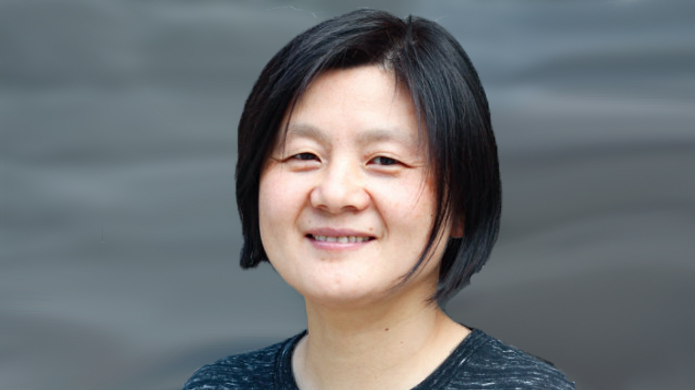
Jessica Dene Earley-Cha: Thanks everyone. Bye.
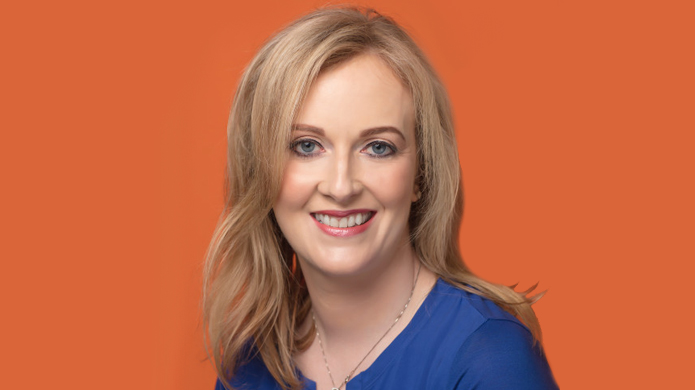
Like what you see here? Our mission-aligned Girl Geek X partners are hiring!

“Scaling a Career in Sales with a Software Engineering Background”: Geetha Anne, Senior Solutions Architect at Elastic (Video + Transcript)

Like what you see here? Our mission-aligned Girl Geek X partners are hiring!

Geetha Anne IG quote Elevate Girl Geek X

Geetha Anne: Hi, everyone. Thank you so much for your time today. My name is Geetha. I am a solutions architect at Elastic. Today, the topic of discussion for the session is how do you start at building a career in sales engineering if you’re already a software engineer? And how can you go about scaling your career in the sales engineer (SE) world? First, I’d like to extend my thanks to the Girl Geek X community for this incredible opportunity. I’ve been a long time follower and I’m so excited to speak on this platform today.

Geetha Anne: Before we get into the topic, a bit about myself. As you can see, I am South Indian. I currently live in the SF Bay Area in California with my family, two daughters, nine and six, they are. My husband who’s also in the tech. I’m in California, so I’ve inherently got in the habit of hiking and I love hiking. I recently finished this Half Dome Summit, which is for me, it’s a great accomplishment because I’ve suffered from an extreme case of acrophobia and I was able to overcome that fear by submitting Half Dome recently.

Geetha Anne: On the right, you see my picture from my graduation day, I did software engineering from San Jose State University back in 2015. That’s my daughter when she was one year old, when I graduated. Before I moved to the US I used to work as a software engineer at Tata, and then I moved here, did my Master’s, and I started off as an intern at ServiceNow in software engineering. Got a full-time as a software engineer, and then after a few months at ServiceNow, I accidentally discovered something called pre-sales exists.

Geetha Anne: Back then in 2015, it was still a niche area for infrastructure backed companies to have a pre-sales function. I was really apprehensive, but I started loving that role ever since. So I worked at Cloudera, Confluent and Elastic recently. As a software engineer, my mind used to work like this. It’s an exact representation of how my mind would function and think like when I was an engineer. Maybe some of you can relate to this because I had technical knowledge, I had creativity, curiosity, but was wet behind the ears in terms of experience.

Geetha Anne: When I was chasing technical knowledge and creativity, I would lose out on curiosity and experience because curiosity will be killed when you follow a monotonous routine, which is usually the case in these SDLC life cycles. You follow the rules that were set in by others and then you lose the curiosity side.

Geetha Anne: I did have inherent curiosity and creativity, but then I did not have the right amount of technical knowledge in order to implement my curiosity and creativity into a real existing, real executable program or a project because I didn’t have experience. Putting all these diagrams together, I was looking for that magic to happen, which never happened when I was a software engineer because I was lacking one or the other.

Geetha Anne: In order to kickstart my journey, in order to really propel my career in software engineering, I read a lot of books. On all these books on the screen you see like Mythical Man-Month, the Pragmatic Programmer, and all of the great books you see on the screen, they give you a perspective to think of software engineering as an art form rather than a science.

Geetha Anne: As with painters, when you draw parallels between art and software engineering, as with painters, I’ve seen so many software developers who only replicate things and really never come up with something original. I was someone like that. I used to be a great painter, a great engineer who replicated things, who really created projects that were similar to others and did a great job at it. But what many other software developers in the organizations were like this genuine artist who are different. They came up with new things, they set new standards for the future. They changed the current environment to me and the status quo for the better, and all the great things they could achieve as these really passionate quarters and programmers, which I was not. I was not a passionate programmer.

Geetha Anne: I did know programming well enough to read code, make the changes, and really suggest optimization techniques and whatnot, but I was really not into it. And then reading all these books taught me to think pragmatically, to present a collection of tips to improve the development process, how to think in a pragmatic way then a theoretical way. I also became an early adopter of inquisitiveness and critical thinking and realism.

Geetha Anne: That set me on a path to define set rules for myself, a guardrails for myself. Like if I were to stay in the software engineering role, I will have to do these things, X, Y, Z things. And the first thing was grasping the fundamentals for the long-term benefit. That was one thing I told myself. This can be elementary as it can appear at first, but having a solid foundation in fundamentals will always need to be, it should come first.

Geetha Anne: The better you understand, the easier it becomes when you’re going onto these advanced concepts. I also set myself a rule that I will learn by doing. I always play with the code while learning. The sooner I started playing with the code, the better I got and faster at learning these given advanced topics. Fiddling around with this code made me realize that I’m capable of not only changing this code, but maybe create my own code when required.

Geetha Anne: I also learned quite a bit from bugs. Bugs, they are inherently going to appear in software programs when you write, right? They are part of fully acceptable process and a phenomenon, and it’s a commonly occurring situation that bugs occur. I’ve learned quite a bit from my own bugs as a software engineer, but it was not fulfilling enough. I really needed that new avenue.

Screenshot at .. PM

Geetha Anne: I wanted to learn what’s happening on the other side of the fence, what’s happening in business. I always was inquisitive. I wanted to see what goes in that realm, but I didn’t know where to start. But there was this miraculously an opportunity showed up when I was at ServiceNow. They wanted someone to demo the project at a sales kickoff that I was part of.

Geetha Anne: I didn’t really know what sales kickoff meant at that time, but I signed up for that opportunity because no other engineer was willing to go to Florida. I signed up for that opportunity and fortunately that worked in my favor because it opened doors for so many things in my life that my career has completely transformed from then on.

Geetha Anne: I was there in Florida at the sales kickoff. As I was demoing the product and interacting with my sales peers at the time, I’ve learned incredible life lessons in professional way. I’ve learned that sales actually plays such a crucial and important role in every business. I was so late in the game to understand that. I really did not have a full picture of what’s going on in the organization.

Geetha Anne: I came about to understand that there’s no matter how good your operations are, how cutting edge your technology is, how good of a programming prowess or engineering prowess you have, and how tight your financial goals are, how progressive and forward-thinking your management and engineering techniques are, you still will need a great sales mechanism in place in order to make any business profitable.

Geetha Anne: After that particular day, some switch flicked in my brain and I started researching more and more about sales and I came across this quote, which is my favorite. “Nothing happens, nothing really happens until someone starts selling something.” That’s when every transaction starts, every enablement starts, and everyone starts to know what’s in the world out there.

Geetha Anne: Once that realization came to me, I started researching and I found that there are majorly two roles across every business in every industry. It is primarily sales and sales support that will make you profit, that will make any business profitable. Every other business function is redundant if sales team fails.

Geetha Anne: If sales fail to sell a product or a service, it will lead to cascading effect of generationally failing income cashflow and also other functions failing in a business. You should take it seriously that there is no other department or business function that can have a greater impact on the development of all cash flows, all important cash flow than the sales or for that matter marketing department.

Geetha Anne: When that realization came, I started research about pre-sales. What is pre-sales? In my opinion, pre-sales is this awesome function within any sales led or a product led company, which is about empowering and educating your buyers, prospects and customers.

Geetha Anne: Pre-sales means it is as simple as guiding your product buyers through their buying journey and proactively anticipating challenges that might occur. It is far more than technical sales. You will have to know about the solution in and out as a sales engineer, as a pre-sales engineer, it is knowing your buyer’s needs ahead of time and you being the expert in the room, you will help them successfully advance to the finishing line of the deal. This is a responsibility of the sales engineer.

Geetha Anne: And if you aren’t from the sales industry, the term pre-sales will apply to all activities before the sales event starts. That’s why the pre in pre-sales comes from. And then by definition, pre-sales will include all marketing and lead generation up to sales qualified lead.

Geetha Anne: Is there need for pre-sales engineers in the market right now? The answer is a big yes. This is the case decade ago. It has only become extremely crucial to hire more pre-sales in a product led or a sales led growth companies. The way it works is once a sales organization sets a sales qualified lead, this sales team will work in converting the lead internal opportunity. Then you work on that opportunity to closure, to win the deal, and all of that activity. In this process, the sales reps are focused on working on the opportunity.

Geetha Anne: There are so many areas where the technical resources are needed and the assistance is required in winning that opportunity. This is where the sales engineer or the SE comes into play to save the day. The activities performed by sales engineers include early demonstrations, technical discovery, comprehensive tech demonstrations, filling something or as request for RFIs, request for proposals, technical validations, which are typically the most resource intensive part of an SE journey, often referred to as proof of concepts and proof of value. These are the responsibilities as a sales engineer, you have to analyze and come up with a solution that fits the needs of a customer.

Screenshot at .. PM

Geetha Anne: And as a profession, it’s developed in a technology sales environment where the product and service offerings are extremely complex. It’s not like you’re buying a car where there’s only one person needed to sell and the product is easy to understand and there’s only one decision maker. That’s not the case with selling a complex IT or a SaaS or infrastructure-based technical solution.

Geetha Anne: You often need multiple teams and parts of business are involved, stakeholders are involved in decision making when you close the sale. And in order for that to happen, the pre-sales has to cover a lot of activities that take place. First thing is qualification. You will have to identify and invest in the right opportunities and then you have to… And the SE has to perform.

Geetha Anne: The sales engineer has to perform the opportunity discovery, understanding the landscape of that customer, understanding the context and why they’re seeking the solution from us as a company. And then you map out the requirements of customer to the solutions that are offered by the company. You come up with a success criteria and define and cater, tailor or custom make a demonstration that will cater to the needs of the customer. And then finally deliver on all of these things that are promised after the pipeline is generated. You answer the RFPs, do the internal research, come up with a proof of concept and deliver. This is all in the hands of a pre-sales engineer.

Geetha Anne: But how do pre-sales engineers go about doing it? You don’t have to do it, there are so many frameworks that are in the market that will help you do that. The first one is K-I-S-S principle, which is very simple, which will help the customers to be told what they’re going to be told. Like the sales engineer is going to tell them what they’re going to tell and they’re going to tell what they’re going to do next and they’ll repeat what they’re told already and keep it very simple. And they’ll repeat the process of keeping them completely informed on where they’re going and how they’re evolving in the journey of customer success.

Geetha Anne: And the next one is LAER model, which is a successful framework used in managing objection handling, when it comes to pre-sales software sales. There’s so many objections that come up in business related contexts like price related objections. There’s quality of service risks that customers are worried about, and there’s relationship and trust-based credibility issues or legitimacy issues that customers are worried and raise an objection about.

Screenshot at .. PM

Geetha Anne: You can use this LAER methodology in order to overcome that fears that they have. And there are many other techniques like MEDIC, which is a sales qualification framework used by a lot of salespeople to help qualify the sales using certain metrics like who are the economic buyers, who’s the decision criteria based off of, and what’s the decision process? What is exactly the pain point and who’s the champion?

Geetha Anne: After understanding all of this, you will come to terms, you’ll also understand the responsibilities and know what to expect in an SE role. You will have to equip yourself as an SE with certain competencies. The first thing being, so in order to be a successful SE, you need a lot of skills that are very much soft skill based. The first thing is communication skill, which is a presentation skill. In other words, you are the face of the customer, right? You are the face of this company in front of the customer, so you will have to have innately the ability to create high value presentations of the company you’re representing.

Geetha Anne: When you start as a junior SE sales engineer and you grow and work your way up to the level five as an SE or a staff or a principal SE, your responsibilities are growing. At first, you’re only expected to understand the audience, create a messaging that caters to them, and deliver those demonstrations.

Geetha Anne: As you grow up, as you work your way up, you will be expected to be extremely skillful and create a compelling case for why the customer has to buy your product. And your ability to deliver compelling messaging, your depth of knowledge, breadth of knowledge, and your ability to speak to a multitude of products, disparate concepts will matter and you will be sought out as a high value presenter. And you’re expected to be on your own when it comes to demonstration skills, when you’re going from level one to level five as an SE.

Geetha Anne: The technical acumen is a non-negotiable skill every sales engineer is expected to have. Because imagine this, right? You are standing in front of the customer representing a product and a company. Your familiarity, your depth of knowledge, and your complex understanding or in-depth understanding of a product in a range of technical topics on that product will only position yourself for success. And you are offering so much value right away and you’re bringing so much to bear already.

Geetha Anne: You are familiarizing yourself with the core products. You are positioning yourself as an expert in this particular technology. You will be having will be expected to have ability to troubleshoot the technical issues. You will also master all this one step at a time.

Geetha Anne: At one point you’ll become an SME of some category of the product and you’ll be capable of running your own meetings, creating your own demos, proactively applying all the emerging trends, and advancing your sales and differentiating from the competitors. Creating competitive materials and making it repeatable is another skill you will also hone.

Geetha Anne: Another skill that’s important is relationship management because you are dealing with salespeople here. You are on a daily basis sharing your knowledge, understanding the landscape. You are constantly evolving these processes. Whenever there’s money involved, it has to be dealt very, very carefully.

Geetha Anne: You have to have exceptional process and project management skills. You don’t have to have it right away, but you are expected to learn as you grow in front of these customers. You’re answering these complex RFPs, you’re presenting topics that are disparate. You will have to become a trusted advisor and their own champion in order to gain trust and credibility.

Geetha Anne: What are the great qualities of an SE? I’ve observed that a great SE is a business operator, meaning, which they view every opportunity as an incredible way of winning that particular account. Their win rates for opportunities of SEs are extremely high, and they’re also people developers, meaning which they contribute back to the SE world by creating tech enablement and all the on-boardings and trainings and creating other kinds of value creation avenues like videos, blog posts, and also articles.

Geetha Anne: And then, after all that, we’ve seen the competencies. There’s a career path for every SE. Most companies replicate this pattern that you’re seeing on screen. They start off as an SE, then there’s a promotion that happens to senior SE and there are two pathways you can take from there. One is become an individual contributor or you can go in a management pathway and manage other sales engineers. The max you can go is a principal SE, and from there you can pivot to management whichever way you want, which is very similar to software engineering, but slightly different in terms of your expectations and how you progress in each level will define where you will find yourself a suitable fit.

Geetha Anne: Above all, topping all this, you need a great mentor. I highly recommend finding a good mentor. First, outline your professional goals. Seek a mentor within the organization or externally who can align with your professional goals, and you can establish a connection with that person and then develop a mutually beneficial relationship. I’m open to mentor anybody who’s willing to move into sales engineering career.

Geetha Anne: These are some of the resources that helped me put together this. And also in my day-to-day job, I refer to these books and resources on a regular basis. Thank you so, so much for this opportunity and I hope to meet some of you on my LinkedIn and great, I hope you enjoy the rest of the conference. Bye.
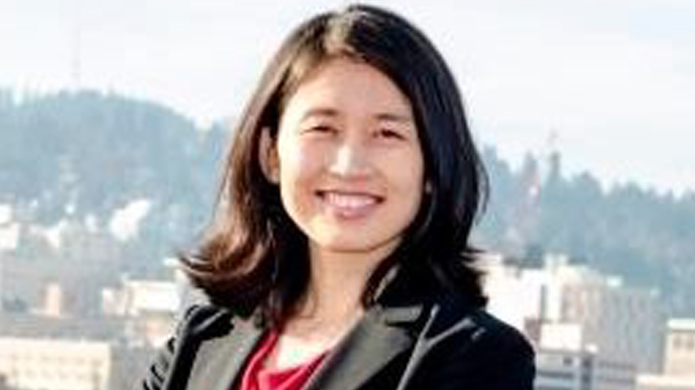
Like what you see here? Our mission-aligned Girl Geek X partners are hiring!

“Compensation at Startups: How To Negotiate For Founding Engineer Roles”: Danielle McLaughlin, Founding Head of Talent at The New Club (Video + Transcript)

Like what you see here? Our mission-aligned Girl Geek X partners are hiring!

Danielle McLaughlin IG quote Elevate Girl Geek X

Angie Chang: My name’s Angie Chang, founder of Girl Geek X, and we have with us today Danielle McLaughlin. She has a decade of experience in recruiting and talent leadership at some of the fastest growing companies in tech, including Square, Lyft, Waymo, Blend, Fitbit, and Fast, and with her deep knowledge of a technical root recruiting environments and methodologies to help businesses scale, Danielle is currently the founding head of talent at The New Club. She helps engineering women land impactful roles at startups and we’re excited to hear her talk today. Welcome, Danielle.

Danielle McLaughlin: Hi, everyone, I’m Danielle. I’m one of the founders of The New Club. Super excited to be here today. I lead our talent initiatives at The New Club, but we will tell you all about that in the session a little bit later today. In case you don’t know about The New Club, we are a private network for women in engineering. We offer community and job search support for finding roles at startups.
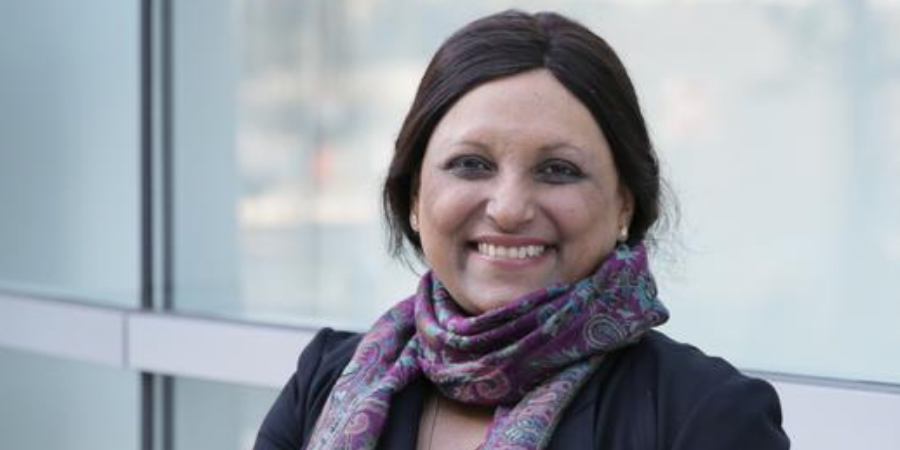
Danielle McLaughlin: Today, I’m going to be talking about how to negotiate at early stage startups. It’s a topic that I get asked about a lot from our community members, how to transition from larger companies to startups and how to talk about equity. I’ll quickly flash today’s topics and key points around getting clear on what you want, what questions to ask, and compensation breakdowns, all part of the journey of your job search.

Danielle McLaughlin: A little bit about me, I’ve been recruiting for 10 years. I’ve worked at a number of different startups and large public companies ranging from two employees to 5,000 employees. I’ve worked for companies like Lyft, Waymo, Fitbit, and Square, and I’m really passionate about helping people, particularly helping technical women excel in their careers. Outside of work, I teach yoga, I spend time with my dog, Fred, who’s here on the screen, and I love to spend time in nature.

Danielle McLaughlin: For today’s session, I wanted to clarify the focus for the advice in this presentation. There’s a lot of nuance in the startup world from bootstrap businesses to VC backed ventures, all stages and sizes. I’ve decided to focus on the most common scenario I get questions on, which is negotiation for the first engineer or early engineer out of venture backed startup, more specifically, pre-seed to series A or within the first two to 15 employees.

Danielle McLaughlin: The first step, the first step in any successful negotiation is getting clear on what you want and understanding where you’re at in your overall career progression today. At The New Club, we host retreats for women in engineering, including workshops on this very topic. All the photos you’ll see in today’s presentation are actually from one of our most recent retreats where we talked about career design and setting goals and milestones. I’ll touch lightly on the stages of the job hunt journey.

Danielle McLaughlin: The first step is really to clarify what you want from your next job and clarify where you’re at in your career today. The second step, defining what types of opportunities fulfill those. The third, evaluating startups potential, which we’ll cover a little bit today, and of course, we’ll also cover negotiation on compensation and equity. Before you interview at an early stage startup, it’s important to think about some of these questions at a deeper level than you would maybe in your standard job search.

Danielle McLaughlin: You’ll be jumping into a riskier venture that will push you in ways that you don’t expect. Some questions to think about might be what are the key skills that you bring to the table that set you apart from the other early team members, and this can be really beneficial when you’re working in a small team. Each person should bring something unique to the table and you really want to have a strong sense of what your unique skills are. The second is what is your collaboration style? How do you work in teams? Do you prefer remote or in-person environments? Are you an extroverted problem solver? Do you like to think out loud or do you like to work through problems on your own?

Danielle McLaughlin: When working in a small team, these types of differences between team members can be super, super helpful to iron out as you’re getting to know your team before you join an early stage venture. The third is how do you usually resolve interpersonal and communication issues? Working in a small startup means working in a high stakes environment where stress is likely to come up a little more frequently. How do you handle stress? How do you communicate when you’re under pressure? These can be really good things to think about as you’re going through the negotiation processes. As you’re meeting new team members, you want to have a sense of how you like to work and communicate that to your new team.

Danielle McLaughlin: The fourth is how much flexibility do you have in your life across your time, finances, or energy? I find this comes up a lot in startups when people are thinking about potentially making the move. They say, “Well, I just don’t have the time to really work on a startup 24 hours a day.” In reality, everyone is in the same boat at an early stage startup and everyone has different amounts of flexibility in their personal life. Setting these expectations upfront can really help your team to succeed and you can really work together to design a working environment that works for all of you.

Screenshot at .. PM

Danielle McLaughlin: All right. Next, questions to ask before talking compensation. These are questions that will likely come up as you’re talking to this potential startup. I’ll be focusing on these questions because I usually get asked about how to negotiate the financial health of a startup from women in our community.

Danielle McLaughlin: The truth is that in early stage startup, there’s a lot of variability in businesses and the companies we’re talking about, maybe pre-revenue, they may be pre-product market fit. The first two questions are best in that type of scenario. If the company is series A maybe and beyond, you may be able to go into the last two in more detail. I’ll start with what is the founder’s philosophy on compensation?

Danielle McLaughlin: This really matters in the early days as a lot of different founders have different ideas of what pay should look like at an early stage startup when there is no product and there is no revenue coming in. Should all of the founders take the same amount as the first five people on the team in terms of their base salary? Should equity be equally distributed, and then how should that grow over time? You also might want to ask if they are paying at a certain percentage of the market, and I’ll talk more about this later on, but these are all questions that you can use when thinking about your own compensation within the startup later on.

Danielle McLaughlin: The second is what’s the founder’s approach and success rate with fundraising? This is a very important question, especially if you are looking at a founder that this is their second venture, and you want to really understand what their approach to fundraising is going to be in the future. Are they going to fundraise on an annual basis and are they looking to bootstrap the business? There’s a lot of complexity there, as well as who are their previous investors. The last two, as I said before, are probably going to be more relevant for companies that are a little bit further along. What is the company’s burn rate?

Danielle McLaughlin: How much money are they spending on operating expenses and salaries month over month, and what is the company’s annual recurring revenue, if any? When you’re understanding the health of a company, a startup, the last three questions will be crucial to understanding the health of the business. For example, if a company has only raised a million dollars and they have no recurring revenue and a burn rate of 100K per month, they will not last very long or more than a year. I can talk more about that in more depth in one-on-one sessions if you would like help understanding the financial viability of your startup. All right, the meat of the presentation.

Danielle McLaughlin: Let’s get into breaking down startup equity. How does startup compensation work? The world of private equity is quite complex, so for those of you who maybe work at a public company, you might be moving from RSUs to options. Terms might come up like common stock versus preferred, dilution is a topic that I get asked about a lot, which I’ll cover in not a lot of detail because we only have a short period of time today, but general guidance, I think, is good to know. A good benchmark for distributing early equity. Ownership of equity between investors, founders, and employees looks a bit like this.

Danielle McLaughlin: Founders generally will get 50 to 60% of the equity pool, investors will get about 20 to 30% of the equity pool, and employees about 10 to 20%. That last 10 to 20% is the amount of equity that will be distributed amongst employees, but not all of it will be distributed in most cases.

Danielle McLaughlin: What are equity percentages and basis points? Equity percentages help you project what you will potentially make from your grant long-term. These are some industry benchmarks around how much engineers might expect to get at the early stages. Co-founders may expect to get 30 to 50%, first founding engineers anywhere from 0.5 to 5%.

Danielle McLaughlin: At the bottom, I’ve broken down a very simple conversion rate for basis points, which are a cleaner way to reference your ownership amount, but they’re usually used by investors, traders, and analysts.

Danielle McLaughlin: Basis points are helpful when thinking about dilution of equity, which we won’t go into in a lot of depth today, but maybe a simple way to think about it is if you’re getting less than one basis point, you may not be getting a significant amount of equity at this stage as an early engineer. To break this down a little bit further, we can see for our first founding engineers and our early founding engineers, your equity percentage lowers with time and increases with impact.

Danielle McLaughlin: The earliest engineer that is going to be the most impactful to building the product, maybe pre-revenue, pre-product market fit, can argue for a much higher percentage of the company as they’re going to be the first person building the product and really helping the company succeed. The more engineers that join the company, the lower the percentage will go as relative to impact.

Danielle McLaughlin: Let’s jump into an example. Let’s say you are a level five software engineer at Meta with five years of experience. You have a bachelor’s degree and a master’s degree in a field that’s relevant to the company that you are interviewing at.

Screenshot at .. PM

Danielle McLaughlin: Your offer is a senior software engineer at an AI company, very relevant to your background, and your offer is 180,000 with 0.8% equity. How might you think about negotiating for this role?

Danielle McLaughlin: To start, you would want to take a look at market data. This is how the company may be formulating your offer. They will look at a few factors ranging from valuation, capital raised, company size, role and scope. In terms of the offer that you would see in market data, you will look at percentages. It looks like for the offer that I shared in the previous slide, the company decided to come in at 180,000 cash, which is at the 50th percentile, and 0.8% in equity, which is a little bit above the 75th.

Screenshot at .. PM

Danielle McLaughlin: When you’re thinking about your offer, what’s negotiable here? First, I might ask for a different title. If you are within the first few engineers, if you’re going to be building the product and there’s no revenue coming in, you’re really going to be a crucial part of this business. You are truly a founding software engineer, so I might ask for that.

Danielle McLaughlin: The second is the trade-off between equity and cash. If you’re at a point in your life where maybe you don’t need as much cash right now, you can certainly trade that off and ask for more equity. If on the other end, you are looking for more cash right now, you can ask for a lower percentage on equity.

Danielle McLaughlin: Of course, there are other examples here where you could ask for more or less on these components and I would’ve to talk to you at a case by case basis to review that, but the last point is discuss expectations on comp and title and responsibility in the future.

Danielle McLaughlin: I’ve seen a lot of creative strategies here where I’ll see folks put in their offer letter. At a year, I’d like to review my compensation or get X percentage if the company hits X goals. That’s it for the content. Here’s some additional resources that were really helpful for me.

Danielle McLaughlin: The first is a book, Getting to Yes. This was actually given to me by one of my first managers and mentors in recruiting. It has certainly helped me a lot.

Danielle McLaughlin: The second is a Master Class. Chris Voss teaches the Art of Negotiation. These are very simple, short videos. You can listen to them before work. I find them really practical and helpful, and the third is The New Club talent. Our community and company, we help women find jobs at startups, we help with negotiation and other areas related to job search support. The last two, these are really excellent resources for compensation at startups. Topstartups.io is actually built by Linda Zhang, who’s a female entrepreneur so love linking that one, and then the last one, Pave is a new and popular resource for companies so wanted to list that one too, and that is it.

Danielle McLaughlin: I’d love to answer any questions in the chat and you can follow this Bitly link to link to our website. Okay. Questions, can you give us an example of where you can negotiate a higher salary on both base and equity and how you would approach the negotiation of convincing the startup to give you what you want? Great question. She is referring to a previous slide where we talked about the offer here in relation to market percentages and then this trade-off example that I gave. It’s true that if in all cases, you don’t need to trade off equity or cash, I think that using data to come into the conversation can be super useful. Remember that your founders may not be experts in this space.

Danielle McLaughlin: Sometimes there’s a bit of education that happens at this stage, making sure that you have both this market data and your personal factors that you’re bringing into the conversation. I often see people leverage other offers. Maybe the startup that you’re talking to doesn’t have a good sense of market data and you can bring those offers to the table and talk about what you’re seeing in the market as a leverage point for asking for more. I would also argue that if you are going to be really, really impactful to the organization, you want to show that and argue potentially for level or comp at a higher level potentially than what they have offered.

Danielle McLaughlin: Great question. Let me look at the next ones. Can you speak more about the percentage and base for non-tech and the same question? Yeah. So this data is available for non-engineering roles as well, and the compensation percentages for those are formulated the same. The same methodology applies here, the same negotiation tactic. Depending on the type of company or the type of role, your skills will be more beneficial to that company. For example, if it’s not a technology company, if it’s a company that focuses more on SaaS or some other kind of business related area, your skills might be way more relevant and therefore, your equity percentage could be much higher in those cases. I would apply the same methodologies that I talked about here for engineers to those roles. Good questions though.

Danielle McLaughlin: What are good places to look at for market data? I shared a couple of examples towards the end of the slide. Topstartups.io is a great one, Pave is a great one. Levels.fyi is a crowdsourced website as well. Those are all really great resources to look at compensation data. I will say though, for a lot of the resources that I’ve seen online, the base salary reported in those examples is usually more accurate than the equity, and the reason for that is the values are listed in Levels.fyi, for example. The actual dollar amount is listed as an example and that can be highly variable depending on how the company views its valuation or how the person has calculated their own equity if they’ve received other grants throughout their lifetime there.

Danielle McLaughlin: I do think that one is a great resource. Your example was for a startup that raised 5 million. How would the approach to equity differ for an early stage that raised more than that? Yeah. Well, if the company is worth more money, your percentage is going to be worth more. The conversation would mostly change around that. You might actually receive what looks like less of a percentage if the company is more valuable, but yeah, I can talk more about that one-on-one, Rebecca. Would love to help you if you have an offer there, but yeah, thank you guys so much for having me, and thank you, Angie.

Angie Chang: Thank you, Danielle. So Danielle will be back on stage at 11:50 to talk about The New Club and then in her virtual booth, The New Club at noon to 1:00 PM Pacific time. So please go chat with her there as well and we’ll be hopping to our next session. Thank you, Danielle, and see you in the next session, everyone.

Like what you see here? Our mission-aligned Girl Geek X partners are hiring!

“Destroying the Menopause Stigma”: Debbie Dickinson and Markea Dickinson-Frasier, Co-Founders of Thermaband (Video + Transcript)

Like what you see here? Our mission-aligned Girl Geek X partners are hiring!

Markea Dickinson Frasier IG quote Elevate Girl Geek X

Angie Chang: Today we have with us the co-founders of Thermaband, Debbie and Markea. I’m going to kick it off as I’m going to say welcome because I’m sure they have great introductions for themselves and welcome to ELEVATE.

Markea Dickinson-Frasier: Thank you.

Debbie Dickinson: Thank you. Hi, everyone. Debbie and Markea Dickinson here, dynamic mother-daughter duo. Happy to be with you this afternoon.

Angie Chang: All right.

Debbie Dickinson: Awesome.

Debbie Dickinson: We’d love to chat with you today about our innovative entrepreneurial journey, which really started with a hot flash, believe it or not. I remember that moment of realizing how unprepared I was for what is really a very natural stage of life. That has been the impetus for starting this business and for our innovation. I didn’t want my daughters to be as unprepared for this natural season of life as I felt. A little bit about our background too, you know, I practiced law for a number of years, worked in benefits and as an entrepreneur. And Markea?

Markea Dickinson-Frasier: Yeah. I worked in supply chain and manufacturing for consumer goods company, Unilever. We actually were able to incubate the business while I was getting my MBA at Yale.

Debbie Dickinson: Excellent. Like puberty, every woman will experience menopause. It’s a very natural evolution of our reproductive cycle, yet we’re so unprepared and so little conversation, so we’ve been part of the movement to really normalize and de-stigmatize because many women say, I’m not there yet without realizing that menopause can start as early as in our thirties and forties and really lasts for the rest of our lives.

Debbie Dickinson: What we’ve done is try to de-stigmatize and normalize menopause and women’s health, open and active conversations about women’s health and mobilize, really created a community and joined a number of other communities as well.

Debbie Dickinson: We have a community, 70,000 plus strong women talking about health and wellness, educate, share information, learn as much as we can because that’s so important and really a platform for us to innovate.

Screenshot at .. PM

Debbie Dickinson: As dynamic women, we all are, we can create the solutions that we wish to see because our vision and our voice really matters. A quick background here, I’m not going to spend too much time. Over a billion women are in menopause and we’re tackling hot flashes and night sweats or what’s called thermal dysregulation, but the fact of the matter is that it significantly impacts our quality of life and health and economic outcomes, and very few of us receive the type of information and assistance that we need, so we have to be advocates.

Debbie Dickinson: Perimenopause, that’s the years leading up to menopause varies greatly in terms of what that is. Menopause is actually a single day that we’ve gone without our period for a full year, believe it or not, the technical definition of menopause is that one day. And then everything after that is post menopause, rest of our lives, lots of symptoms and things that can occur. At the end of the day, we just want to know what that is.

Debbie Dickinson: Next screen shares that there are 34 symptoms that we recognize in the US, 48 in the UK. A list is here. You can see it varies quite a lot when someone says, I’m not there yet is because they don’t realize that dry skin and headaches and bloating and depression and anxiety and that sort of thing may very well be related to fluctuations in hormones and menopause. We have to normalize, understand what’s happening and create these solutions.

Screenshot at .. PM
Screenshot at .. PM

Debbie Dickinson: What we recognize very quickly is that the time is now for innovation and for women’s health, which has been vastly overlooked for so many years, and it’s only since ’93 that women were actually included in research studies and we know that our bodies are very different. We’re just going to talk now about our innovative approach, what we have done and our journey and are excited to share that. Markea?

Markea Dickinson-Frasier: Awesome. The reality is we set out to really change the space in terms of the menopausal space and destigmatizing and normalizing, but it’s like how do you go about doing that? Right? How do you go from an idea to actually executing in different ways? Debbie and I talked about in the beginning with our background, we’re actually both non-technical founders and we’re building a very technical product, which really is, we’ll get into it a little bit, but really is this device that cools and warms your body for different reasons, different things that you might be experiencing. One thing that we’ll talk about in the beginning is, or one thing we’ll talk about now is really how do you go about building a product or a service outside of your area of expertise? We’ll share some tips and tricks of things that we’ve done.

Markea Dickinson-Frasier: One is just being a sponge, you know, really learning, taking the time to learn, know what you know, know what you don’t know, and then find people that you can surround yourself with and know what you don’t know.

Markea Dickinson-Frasier: Building your village, you know, we wrote down some things, some types of people that have been really helpful for us, whether it’s clinicians, scientists, other founders that are in different companies or founding different companies, community groups.

Markea Dickinson-Frasier: We’ve really partnered with different menopausal groups to be able to learn from them in different areas, whether it’s investors, advisors, and then digging a bit deeper. It was really helpful to leverage accelerator and incubator programs.

Markea Dickinson-Frasier: Some of the ones that are listed here are some of the big names like Techstars and Y Combinator. One of the lesser known ones that we were able to leverage is Google for Startups, which was a really, really good, they actually have a women’s program and they have a people of color program as well.

Markea Dickinson-Frasier: It was really helpful to tap into that network to really learn the things that we didn’t know. This is our first business and it was really helpful to leverage some of those programs. We also were able to leverage local universities that we had gone to, you know, tapping back into our universities. I went to Penn State for undergrad. Debbie went to Penn for undergrad, and it was really, really helpful to tap back into those networks and students and local innovation labs.

Markea Dickinson-Frasier: Another really helpful thing when it comes to more individuals has been to leverage freelance service marketplaces, so interns, being able to leverage interns from universities. When it comes to freelance service marketplaces like Upwork, Fiverr, how we got to our first iteration, our MVP was really leveraging an engineer that was located abroad from Upwork. It was really, really helpful not to spend a lot of money to really build that first MVP or minimally viable product. It was really helpful for us to go about it in that way in a very, very lean way.

Markea Dickinson-Frasier: Another helpful tip in terms of how the path that it took to get to our product really was staying true to your convictions. On the same note of destigmatizing, the reality is that women often are addressing market segments from life experiences that might not be always understood by different environments, especially male dominated environments.

Markea Dickinson-Frasier: We had several advisors and investors tell us that quote unquote no one’s going to care about menopause. “You know, you guys should pivot to a different market”, “pivot to athletes”, “pivot to different directions”. It helped us to be prepared and know our numbers when it came to standing firm in the market that we wanted to pursue. It also helped us to just understand the market segment overall because the reality is that we’re serving a very, very large market that if you’re not in it, you might see it as a niche, but the reality is that it’s a very large market overall.

Markea Dickinson-Frasier: The other helpful tip that we wanted to share is where you start isn’t always where you’ll end when it comes to your go-to-market strategy, your market, your distribution, channels, those types of things. Welcome advice, but take them with a grain of salt is something that we also learned along the way. At the end of the day, you know your mission and you know your business best. It’s also helpful to learn to adapt, to be agile, but also making sure that you’re trusting your gut. At the end of the day, you know your business best.

Debbie Dickinson: Absolutely.

Screenshot at .. PM

Markea Dickinson-Frasier: Here we have our product journey, so I think it’s been really interesting. Early on, as you can see in the bottom left, we started iterating. There’s a very, very iterative path and we started iterating very early on.

Markea Dickinson-Frasier: We recognized that there was a problem. There was a pain point that women were experiencing, that people in general were experiencing where they’re uncomfortably warm or uncomfortably cool in a room more so than others that were around them.

Markea Dickinson-Frasier: Wee worked and we gave a seat at the table to women in this process to really advise us on what type of design they would like to see, what type of product they would like to be wearing. Those types of things were really, really helpful. We collaborated along the way and learned as much as we could about this market and what their likes and dislikes were.

Markea Dickinson-Frasier: They wanted a very discreet product that wasn’t going to flash to the world like, “hey, I’m having menopause and I’m experiencing hot flashes”, but be very, very discreet in a way that they could kind of wear it and just navigate the world seamlessly and then also create a community.

Markea Dickinson-Frasier: Debbie mentioned over 70,000 women in our community, we’ll give more information afterwards about how to join on Facebook, but it’s been really, really helpful to collaborate amongst women and people in general along our journey and to collaborate them on the design, collaborate with them to create, test, and innovate in different ways, and then ultimately build a solution that provides immediate hot flash relief and digital health insights.

Markea Dickinson-Frasier: This is our product. We also have a companion app as well, which is really integral. We created a wearable that offers, as I mentioned, hot flash relief and health insights, but also a digital health app as well. It’s still a work in progress, but we have stayed true to our convictions that the menopause market is a market worth serving and we believe that, like you, we can collaborate and create innovative solutions to help change the world.

Debbie Dickinson: Thank you. We welcome any questions.

Markea Dickinson-Frasier: Have any questions? Yeah. Lots of engagement in the chat, which is exciting. Folks are saying, my mom had early menopause, so this topic is definitely top of mind for me. Yes. We’ve chatted with several women that have experienced that as well. Debbie, would you like to address that question? Could you please share the accompanying app for your product? It’s not out on the market yet, but it’s called Thermaband Zone and it partners with the app in a way to provide quantitative and qualitative data in terms.

Debbie Dickinson: Yes.

Markea Dickinson-Frasier: Exactly. You wear it with the wearable and it provides blood pressure, heart rate, those types of things, and really helpful in understanding your body as you’re kind of going through this.

Debbie Dickinson: Yeah. Somebody mentioned that never connected increase in allergies to menopause. And we could actually put up the slide on the 34 symptoms because it’s often a surprise for folks. You know, it’s like there’s so many different things that could be happening with their bodies and it’s so important to check in with your physician, but just knowing that there could be a correlation with these things is very important. And again, my journey realizing how unprepared I was and how much I didn’t know really motivated us to create a community and to start having these conversations. And it’s really through conversing with other women and realizing how the ingenuity of recognizing that just a cool sensation really helped during a hot flash.

Debbie Dickinson: Some women were putting their hands on granite countertops, standing on a cold floor, hands in running cold water, head in the freezer, gel packs, all these different things. It’s like, wait, there’s a commonality here. We recognize that a cool sensation during a hot flash works. Why is that? Connect with scientists and physicians and recognizing that the science of thermo regulation and how that works, and then what is it that the market needs?

Debbie Dickinson: We recognize two things. One is relief and the other was insights, so we can advocate for ourselves and really enhance and elevate our standard of care. So we’re looking at those two aspects with the…

Markea Dickinson-Frasier: We’ve got a question here. What does the wearable actually do? Is it data? Is it somehow cooling or warming? Great question. The wearable actually cools and or warms your body. So you literally wear it on your wrist. Debbie might be actually wearing it. Wear it on your wrist and it cools on the inner wrist. It kind of connects with a pulse point on your inner wrist to provide cooling and warming relief.

Debbie Dickinson: And we can connect, you can send us email Founders@MyThermaband.com. We have had testers, beta testers and early adopters. Happy to connect with those who might be interested. A highlight an experience or challenge that we overcame in the innovation process. Oh my goodness. Where do we start? There’s so many. Fundraising, huge, right?

Debbie Dickinson: Move very scrappily, friends and family around, bootstrapping, so money and having what you need at each juncture. Got to move in a very agile way. That’s ongoing and we’ve overcome that in different ways along the way, including friends and family around and grants and that sort of thing, different funding options. Others is trying to get the resources that are needed.

Debbie Dickinson: Markea mentioned Upwork and Fiverr, so at different junctures, how do you find the talent? Leveraging different communities, other founders, technological I-Labs, whether it’s local I-Labs or through universities, so talent, access to the engineers that we need.

Debbie Dickinson: How to find a company to develop the product to help us design the product to manufacture, those types of challenges. We had a manufacturer actually pull out of an engagement, so that was very challenging. Scramble to find others. We’ve had a number of challenges along the way. It’s resilience. It’s being super committed. It’s recognizing that it’s par for the course. It tends to be somewhat thankless, so you have to be very committed to what you’re doing and purpose. You ride through those tumultuous times. But yeah, lots of challenges that we’ve overcome along the way.

Angie Chang: Thank you for sharing your entrepreneurial journey with us. It was super inspiring to hear you tackling and showing us how you’ve innovated. I look forward to joining the community. Thank you for sharing that’s on Facebook, so now I can look for it.

Debbie Dickinson: Excellent.

Angie Chang: And yeah, we will continue to hopefully hear about how your company is evolving and growing and how we can support, so…

Debbie Dickinson: Wonderful.

Angie Chang: … looking forward to hearing good news and bad from the Thermaband journey. Thank you so much for sharing at ELEVATE.

Debbie Dickinson: Thank you for having us.

Markea Dickinson-Frasier: Thank you.

Debbie Dickinson: It’s been a pleasure. Take care. Bye, everyone.

Debbie Dickinson IG quote Elevate Girl Geek X

Like what you see here? Our mission-aligned Girl Geek X partners are hiring!